
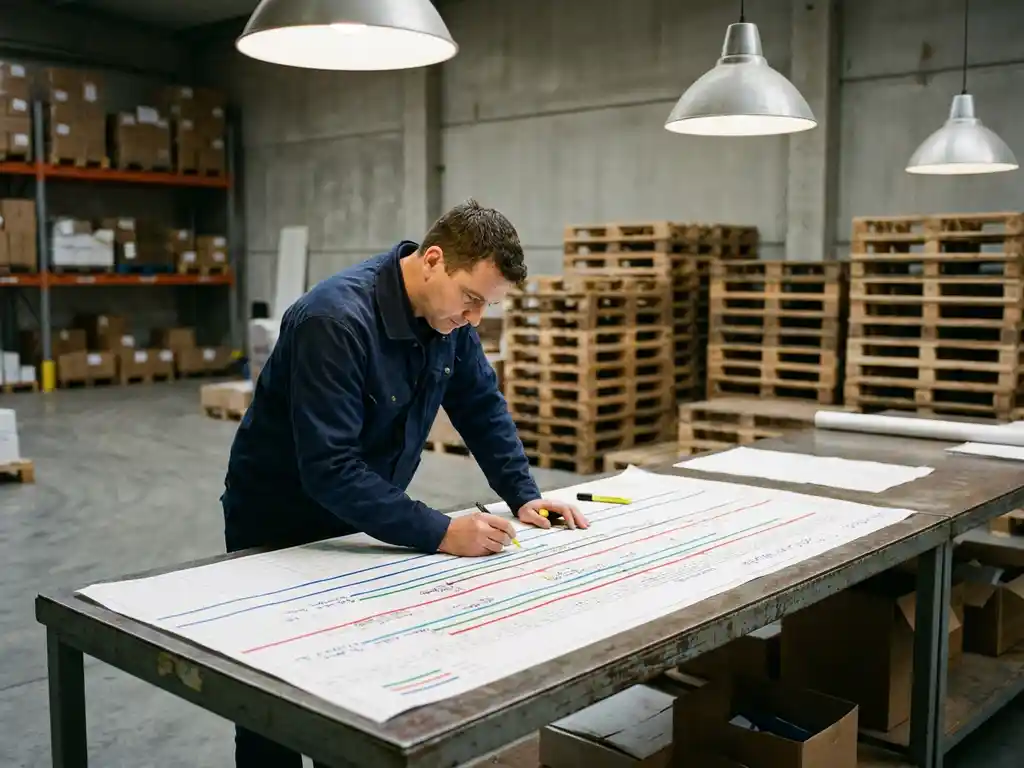
Getting products from point A to point B sounds simple enough. But for large enterprises managing hundreds of SKUs, multiple production sites, and global distribution networks, the coordination required to make that happen is anything but straightforward. Supply chain scheduling sits at the heart of that coordination, and when it works well, it quietly powers everything from on-shelf availability to customer satisfaction. When it breaks down, the ripple effects show up fast: missed deliveries, excess inventory, and rising costs that erode margins.
For CFOs, COOs, and supply chain directors operating at scale, understanding what supply chain scheduling actually involves, and how to strengthen it, is one of the more practical supply chain optimization strategies available. This article walks through the key components, common challenges, and the role technology plays in making scheduling more reliable and resilient.
The core components of supply chain scheduling
Supply chain scheduling is the process of coordinating and sequencing all the activities involved in moving goods through a supply chain, from raw material procurement to final delivery. It connects demand signals to operational capacity, translating forecasts and orders into specific timelines for procurement, production, warehousing, and distribution. Understanding which industries benefit most from structured scheduling can help organizations benchmark their own approach against sector-specific best practices — whether that is smart warehousing, transport, or field services.
At its core, effective scheduling relies on several interdependent components:
- Demand signals: Accurate, timely data on what customers need and when, which feeds every downstream scheduling decision
- Capacity constraints: A clear picture of what production lines, warehouses, and transport networks can realistically handle at any given time
- Lead times: Realistic buffers built into the schedule for supplier lead times, production cycles, and transit durations
- Inventory positions: Real-time visibility into stock levels across the network to avoid both shortages and surplus
- Prioritization logic: Rules that determine which orders or production runs take precedence when constraints arise
These components do not operate in isolation. A shift in demand, a supplier delay, or a warehouse bottleneck can cascade through the entire schedule, which is why integration across functions is as important as the scheduling process itself.
How supply chain scheduling drives operational performance
Strong scheduling discipline is one of the most direct levers for improving operational performance. When activities are properly sequenced and timed, organizations reduce waste, improve throughput, and deliver more consistently to customers.
From an inventory management perspective, well-structured scheduling reduces the need for safety stock held as a buffer against uncertainty. When lead times are predictable and demand signals are integrated into the schedule, businesses can hold leaner inventories without compromising service levels. This directly improves working capital efficiency, a metric that CFOs track closely.
On the logistics side, scheduling that accounts for transport capacity and delivery windows enables better route planning and load consolidation. These are not minor gains. Tighter logistics optimization techniques built into the scheduling process can meaningfully reduce freight costs and improve on-time delivery rates — and dedicated transport optimization capabilities can take this even further for organizations running complex distribution networks. For operations running across multiple distribution points, coordinated scheduling also minimizes the risk of conflicting priorities between sites.
Ultimately, organizations that treat scheduling as a strategic capability, rather than a back-office administrative task, tend to respond faster to disruption and serve customers more reliably.
Common scheduling challenges in complex supply chains
Even with the right intentions, supply chain scheduling in large, complex organizations runs into predictable obstacles. Recognizing these challenges is the first step toward addressing them.
Data fragmentation
Scheduling decisions are only as good as the data behind them. When demand data sits in one system, inventory data in another, and production capacity in a third, planners spend more time reconciling information than making decisions. Fragmented data leads to schedules built on assumptions rather than facts, which increases the likelihood of errors and firefighting.
Siloed planning functions
In many organizations, procurement, production, and logistics teams plan independently with limited visibility into each other’s constraints. A production schedule that looks achievable in isolation may be unworkable once transport capacity or supplier lead times are factored in. Breaking down these silos is one of the more difficult but impactful improvements an organization can make.
Demand volatility
Seasonal peaks, promotional events, and market disruptions can make demand difficult to predict with precision. When forecasts are off, schedules built on those forecasts quickly become outdated. Organizations without dynamic scheduling processes end up either overproducing and holding excess stock, or underproducing and missing service targets.
Rigid systems and manual workarounds
Older planning systems often lack the flexibility to handle real-time changes. Planners compensate with spreadsheets and manual adjustments, which introduces human error and makes it nearly impossible to maintain a single, authoritative schedule across the organization.
Supply chain scheduling vs. production planning: key differences
These two terms are often used interchangeably, but they address different questions. Understanding the distinction helps organizations structure their planning functions more clearly.
Production planning is concerned with what to produce, in what quantities, and over what time horizon. It typically operates at a higher level, translating sales forecasts and inventory targets into a production plan that covers weeks or months ahead. It answers the capacity question: can the organization meet anticipated demand?
Supply chain scheduling is more granular and more dynamic. It determines when specific activities happen, in what order, and through which channels. It takes the production plan as an input and translates it into actionable timelines across procurement, manufacturing, warehousing, and distribution. Where production planning sets the direction, scheduling sets the pace.
For enterprises operating across multiple sites and markets, both functions need to be tightly connected. A production plan that is not grounded in realistic scheduling constraints will consistently generate plans that cannot be executed as intended.
Technology’s role in modern supply chain scheduling
Technology has fundamentally changed what is possible in supply chain scheduling. The shift from static, spreadsheet-based planning to dynamic, data-driven scheduling platforms has given organizations the ability to respond to change in near real time.
Modern scheduling tools integrate demand forecasting optimization directly into the scheduling process, using historical data, market signals, and machine learning to generate more accurate demand inputs. This tightens the link between what the market needs and what the supply chain is scheduled to deliver. Exploring the full range of platform features available in advanced scheduling solutions can help organizations identify which capabilities will have the greatest impact on their specific planning challenges.
Advanced planning systems also incorporate constraint-based scheduling, which automatically accounts for capacity limits, lead times, and prioritization rules when generating schedules. Rather than producing an ideal plan that ignores real-world constraints, these systems produce executable schedules that planners can trust.
For warehouse and distribution operations, warehouse optimization solutions embedded in scheduling platforms help coordinate inbound and outbound flows more efficiently, reducing dwell times and improving throughput. Similarly, distribution network optimization tools allow organizations to model different scheduling scenarios and select the most cost-effective routing and timing configurations.
The organizations seeing the greatest return from these technologies are those that have invested in strong data foundations first. Technology amplifies the quality of the data it receives, which means poor data governance undermines even the most sophisticated scheduling tools.
Building a more resilient scheduling process
Resilience in scheduling is not about building rigid plans that hold under pressure. It is about building processes that adapt quickly when conditions change, as they inevitably will.
A few principles tend to characterize resilient scheduling processes:
- Scenario planning built in: Resilient organizations do not plan for a single version of the future. They maintain contingency schedules for common disruption scenarios, so response time is reduced when those scenarios occur
- Cross-functional visibility: When procurement, production, and logistics teams share a common view of the schedule and its constraints, they can coordinate responses to disruption faster and with less friction
- Dynamic rescheduling capability: The ability to update schedules in response to real-time events, whether a supplier delay, a demand spike, or a transport disruption, is increasingly a baseline requirement rather than a competitive differentiator
- Clear ownership: Resilient scheduling processes have defined roles and decision rights, so when exceptions arise, the right person can act without waiting for approvals that slow response time
- Continuous improvement loops: Post-event reviews that examine where schedules broke down and why create the organizational learning needed to reduce recurring disruptions over time
Procurement process optimization also plays a role here. Scheduling resilience depends partly on supplier relationships and contract structures that allow for flexibility. Organizations that have worked to diversify their supplier base and build in flexibility on lead times are better positioned to maintain schedule integrity when individual suppliers face challenges.
Building this kind of resilience takes time and deliberate effort, but the payoff is a supply chain that absorbs shocks without the costly firefighting that reactive organizations experience repeatedly.
How More Optimal helps with supply chain scheduling
We work with large enterprises to design and implement supply chain scheduling processes that are grounded in data, aligned across functions, and built for the complexity of modern operations. Our approach combines strategic consulting with hands-on execution support, so improvements translate into lasting operational change rather than recommendations that sit on a shelf. Learn more about our implementation services and how we support organizations through every stage of the process.
Specifically, we help organizations:
- Assess current scheduling maturity and identify the gaps that are driving cost, service failures, or planning inefficiency
- Design integrated planning architectures that connect demand forecasting, production scheduling, and logistics coordination in a single coherent process
- Implement and configure advanced planning tools, including More Optimal and Relex, to deliver dynamic, constraint-aware scheduling capabilities
- Build the data foundations and governance frameworks that make scheduling technology reliable and actionable
- Support change management and capability building so that planning teams can sustain and improve the new processes over time
The results our clients see include measurable improvements in forecast accuracy, service levels, and inventory efficiency, outcomes that directly impact both operational performance and financial results. If your organization is ready to move from reactive scheduling to a process that drives real competitive advantage, plan a demo with our team to start the conversation.