
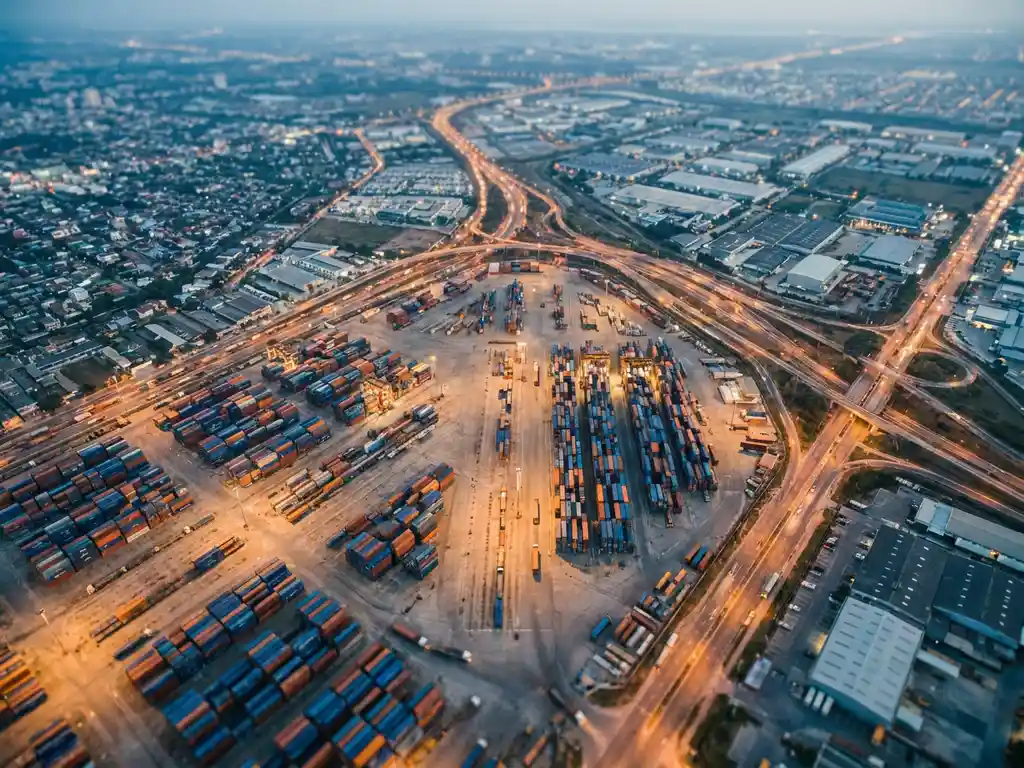
Market expansion is one of the most exciting strategic moves a business can make. But it comes with a hidden cost that many leadership teams underestimate: the pressure it places on an existing distribution network. What worked efficiently at one scale or in one geography can quickly become a source of delays, excess cost, and customer dissatisfaction when the business grows beyond its original design parameters. Distribution network optimization is not just a logistics exercise. It is a strategic enabler that determines whether growth translates into profit or simply into complexity.
For CFOs, COOs, and Supply Chain Directors managing operations at scale, getting the network design right before or during expansion is one of the highest-leverage decisions available. The good news is that with the right supply chain optimization strategies, it is entirely possible to build a distribution architecture that grows with the business rather than against it. At More Optimal, we help organizations do exactly that — across a wide range of industries, each with their own distribution challenges and growth pressures. Learn more about the More Optimal platform and how it supports organizations navigating complex network decisions.
How market expansion strains your existing distribution network
Entering new markets or scaling existing ones introduces a set of structural pressures that most distribution networks were simply not designed to absorb. Customer bases spread across new geographies, service expectations rise, and the number of SKUs, suppliers, and touchpoints multiplies rapidly.
The most immediate strain tends to appear in lead times and inventory positioning. A network optimized for a concentrated customer base often cannot serve dispersed locations at the same speed or cost. Warehouses become either overloaded or poorly positioned, transportation lanes grow inefficient, and the cost-to-serve a new customer segment can quietly erode the margins that made expansion attractive in the first place. Without deliberate distribution network optimization, growth can create as many operational problems as it solves commercial ones.
Key levers in distribution network optimization
Effective network optimization works across several interconnected dimensions, and the most impactful programs address more than one simultaneously. The goal is to find the configuration of nodes, flows, and inventory policies that minimizes total cost while meeting service commitments.
Network footprint and node placement
Warehouse location decisions have an outsized impact on both service levels and logistics costs. Placing distribution centers closer to demand clusters reduces last-mile distances and improves responsiveness. Conversely, consolidating nodes where demand is thin can reduce fixed cost without sacrificing service. Modeling different footprint scenarios is one of the most powerful logistics optimization techniques available to supply chain teams. For organizations managing warehouse operations at scale, exploring dedicated smart warehousing solutions can provide a significant advantage in both speed and cost control.
Inventory positioning and demand forecasting
Where stock sits in the network is just as important as how much stock is held. Inventory management optimization involves deciding which products to hold centrally versus regionally, based on demand variability, lead times, and service requirements. This is closely tied to demand forecasting optimization: the more accurately a team can anticipate demand by location and product, the leaner and more responsive the inventory position can be. Purpose-built optimization features — such as advanced forecasting engines and scenario modeling tools — make this level of precision achievable at scale.
Warehouse and transportation efficiency
Within individual nodes, warehouse optimization solutions such as slotting strategies, pick path design, and automation investments can significantly improve throughput and reduce handling costs. On the transportation side, route optimization, carrier mix decisions, and load consolidation all contribute to a more cost-effective and reliable outbound flow. A structured approach to transport optimization can unlock substantial savings across outbound networks, particularly as volumes grow and lane complexity increases.
Aligning network design with your go-to-market strategy
A distribution network does not exist in isolation. It is the physical expression of a company’s commercial strategy, and misalignment between the two is one of the most common and costly mistakes in supply chain design.
If a business is pursuing a premium service proposition in a new market, the network needs to support fast, reliable, and possibly flexible delivery. If the strategy is cost leadership, the network should prioritize consolidation and efficiency over speed. When these two dimensions pull in opposite directions, operational teams are left trying to deliver a service level the network was never designed to support. Connecting network design decisions directly to procurement process optimization and commercial planning ensures that the supply chain reinforces rather than undermines the growth strategy.
This alignment also requires close coordination between supply chain leadership and the commercial teams setting customer expectations. Service level agreements, order minimums, and lead time commitments all have direct implications for network configuration and cost structure.
Common pitfalls that derail network optimization projects
Even well-resourced organizations struggle to deliver network optimization projects on time and on target. Understanding where these efforts typically go wrong can help teams avoid the most costly mistakes.
- Optimizing for today rather than tomorrow: Network designs built around current demand patterns can quickly become obsolete. Failing to model growth scenarios or demand shifts means the new design may need revisiting within a few years.
- Underestimating data quality requirements: Network optimization models are only as good as the data that feeds them. Poor visibility into actual cost-to-serve, inventory positions, or demand signals leads to suboptimal recommendations.
- Siloed decision-making: When warehousing, transportation, procurement, and commercial teams each optimize their own piece without a shared view of total network cost, local efficiencies can create system-wide inefficiencies.
- Neglecting change management: Network redesigns often require significant operational and organizational changes. Without a structured change program, even technically sound designs fail in execution.
- Treating optimization as a one-time event: Markets, demand patterns, and cost structures evolve continuously. Organizations that treat network optimization as a project rather than an ongoing capability tend to fall behind.
Building a resilient network that scales with growth
The most durable distribution networks are designed with adaptability as a core principle, not an afterthought. Resilience in this context means the ability to absorb disruption, flex with demand changes, and integrate new markets or product lines without requiring a full redesign.
Building that kind of network starts with a strong data foundation. Real-time visibility into inventory levels, transportation performance, and demand signals allows teams to make faster, better-informed decisions when conditions shift. It also enables continuous monitoring of network performance against design assumptions, which is essential for identifying when the current configuration is no longer fit for purpose.
Flexibility in the physical network itself also matters. A mix of owned, leased, and third-party logistics capacity gives organizations the ability to scale up or down in specific geographies without committing to fixed infrastructure ahead of demand. This is particularly relevant for businesses entering new markets where demand patterns are still uncertain.
Finally, the organizational capability to run ongoing network reviews and scenario modeling is what separates companies that stay ahead of their growth from those that are perpetually catching up. Embedding supply chain optimization as a strategic discipline rather than a reactive one is the foundation of long-term competitive advantage. Structured implementation services can play a critical role here, helping teams translate strategic network designs into operational reality without losing momentum.
How More Optimal helps with distribution network optimization
We work with CFOs, COOs, and Supply Chain Directors at large enterprises to turn distribution complexity into a source of competitive strength. When organizations are expanding into new markets or outgrowing their current network design, we bring together strategy, advanced optimization technology, and hands-on execution to build networks that perform now and scale for what comes next.
Our approach to distribution network optimization includes:
- Supply chain maturity and cost-to-serve assessments that provide a clear baseline of where your current network is creating cost or service risk
- Network design and scenario modeling to evaluate footprint options, inventory positioning strategies, and service level trade-offs aligned with your commercial strategy
- Data foundation and governance design to ensure the visibility and data quality needed for reliable optimization and ongoing performance management
- Technology selection and integration support, including tools like More Optimal and Relex, to embed optimization capability into your operational ecosystem
- Change management and implementation guidance so that redesigned networks are adopted effectively across the organization
If your distribution network is struggling to keep pace with your growth ambitions, we would welcome a conversation about what a more resilient, optimized design could look like for your business. Plan a demo to explore how we can help you turn your supply chain into a lasting competitive advantage.