
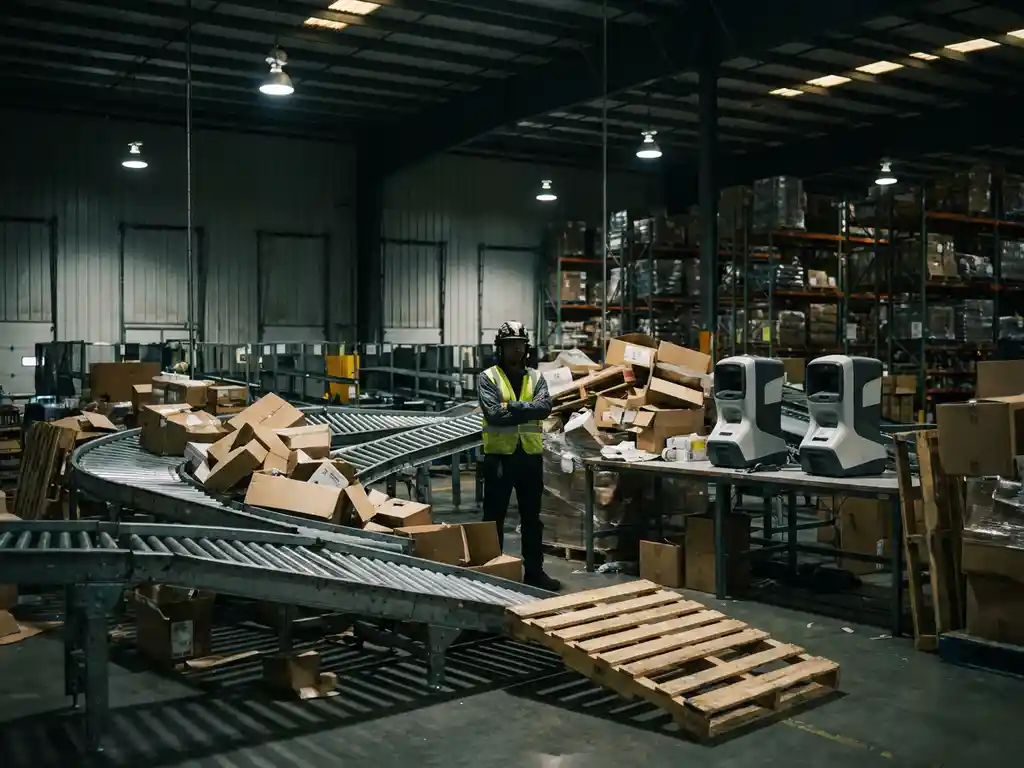
Warehouse optimization solutions promise significant gains: faster picking, leaner inventory, sharper demand forecasting, and tighter distribution network optimization. Yet a frustrating pattern repeats itself across industries. Companies invest in sophisticated warehouse optimization solutions, integrate them carefully, train their teams, and then watch the expected results fail to materialize. The technology works. The processes beneath it do not. That gap is where performance quietly disappears.
For CFOs, COOs, and Supply Chain Directors managing complex, high-volume operations, this is more than a frustrating outcome. It represents real financial exposure and a missed opportunity to convert supply chain investment into competitive advantage. Understanding why this happens, and what to do instead, is one of the most practical supply chain optimization strategies available today.
The hidden gap between warehouse technology and results
Most warehouse optimization tools are built on a critical assumption: that the processes feeding them are consistent, clean, and repeatable. When that assumption holds, the tools perform well. When it does not, even the most advanced logistics optimization techniques produce unreliable outputs. Understanding the full range of features that a well-configured optimization platform offers makes it easier to see why process quality is the determining factor in whether those capabilities deliver value.
The gap between technology capability and operational reality is rarely visible during vendor demonstrations or pilot phases. It surfaces later, when live data reveals inconsistencies, when staff follow different procedures depending on the shift or location, or when the system recommends actions that experienced operators instinctively override. At that point, the investment is already made, and the problem is harder to address.
How process fragmentation undermines warehouse performance
Process fragmentation is the condition where the same task is performed differently across teams, shifts, locations, or time periods. It is remarkably common in warehouses that have grown organically, absorbed acquisitions, or adapted to repeated disruptions without formally updating their operating procedures.
The consequences for inventory management optimization are direct. When receiving processes vary, stock records become unreliable. When putaway logic differs by shift, slotting recommendations lose accuracy. When pick confirmation steps are inconsistently followed, order accuracy data becomes noise rather than signal. Optimization algorithms depend on high-quality, consistent data inputs. Fragmented processes systematically degrade those inputs, making the outputs less trustworthy over time.
Fragmentation also creates a cultural problem. When operators see that system recommendations frequently conflict with their own experience, they lose confidence in the tools and begin working around them. That workaround behavior further corrupts the data, deepening the problem in a cycle that is difficult to reverse without addressing the root cause.
What process standardization actually looks like in practice
Process standardization does not mean rigidity. It means defining a clear, agreed-upon way of performing each core warehouse activity and ensuring that definition is documented, communicated, and consistently followed. The goal is predictability, not uniformity for its own sake.
Key elements of practical standardization
- Documented standard operating procedures for receiving, putaway, picking, packing, and dispatch that reflect how the warehouse actually works, not an idealized version
- Clear decision rules for exceptions, so that when something falls outside the standard, staff follow a defined escalation path rather than improvising
- Consistent data entry conventions that ensure location codes, SKU references, and quantity units are recorded identically across all shifts and teams
- Regular process audits that compare actual behavior against documented standards and identify drift before it becomes embedded
- Cross-shift handover protocols that prevent knowledge gaps from creating procedural variation between teams
Standardization at this level does not require a lengthy transformation program. Many organizations can achieve meaningful consistency within weeks by focusing on the five or six highest-volume processes that generate the most data flowing into their optimization systems.
Building the right sequence: standardization before optimization
The sequencing of supply chain improvement initiatives matters enormously. Deploying warehouse optimization solutions on top of fragmented processes is the operational equivalent of building on unstable ground. The structure may look impressive initially, but it will not hold under real operational pressure.
The correct sequence starts with a process baseline. Before selecting or configuring any optimization tool, map the current state of core warehouse processes with enough detail to identify where variation exists and why. That baseline reveals which processes are genuinely ready to feed an optimization system and which need to be stabilized first. A structured implementation approach can make this baseline work significantly faster and more reliable.
Once a stable process baseline is in place, technology configuration becomes far more straightforward. Parameters can be set with confidence because the underlying behavior they are modeling is consistent. Procurement process optimization efforts also benefit from this foundation, since cleaner inbound processes produce more reliable demand signals for purchasing decisions.
Common mistakes when deploying warehouse optimization tools
Several patterns appear repeatedly in deployments that underperform, and most of them share a common thread: the assumption that the tool will solve problems that are fundamentally process problems.
- Skipping the process audit: Launching a new system without first documenting and validating current processes means the system is configured against assumptions rather than reality
- Over-relying on historical data: If historical data was generated by inconsistent processes, it reflects noise as much as signal. Using it uncritically to train optimization models embeds that noise into future recommendations
- Treating go-live as the finish line: Process drift begins immediately after go-live. Without ongoing governance and periodic audits, standardization erodes and system performance degrades gradually
- Underinvesting in change management: Operators who do not understand why a new process exists, or who were not involved in designing it, will default to familiar habits under pressure
- Optimizing isolated functions: Warehouse optimization that is disconnected from broader distribution network optimization or demand forecasting creates local improvements that do not translate into system-wide gains
Turning standardized processes into a lasting competitive edge
Standardization is often framed as a cost-reduction measure, but its strategic value goes further. When processes are stable and well-documented, the organization gains the ability to learn systematically. Performance data becomes meaningful because it reflects genuine operational behavior. Experiments and improvements can be tested with confidence because the baseline is known.
That learning capability compounds over time. Organizations with standardized warehouse processes adapt faster to disruption, onboard new technology more effectively, and scale operations with less friction. They also produce cleaner data for demand forecasting optimization and procurement process optimization, which creates feedback loops that strengthen performance across the entire supply chain. This is especially relevant across the industries we serve, where operational complexity makes a clean data foundation all the more critical.
In a competitive environment where speed, accuracy, and cost efficiency all matter simultaneously, the ability to improve continuously and reliably is a durable advantage. Warehouse optimization solutions are a powerful enabler of that advantage, but only when the process foundation beneath them is solid.
How More Optimal helps with warehouse and supply chain optimization
We work with CFOs, COOs, and Supply Chain Directors at large enterprises to close exactly this gap. More Optimal’s approach combines supply chain strategy, process design, and advanced optimization technology to build the foundation that makes warehouse and supply chain investments perform as intended. Learn more about what we do and how we help organizations unlock the full value of their supply chain investments.
When organizations partner with us, we bring a structured methodology that addresses the full picture:
- Supply chain maturity assessments that identify where process fragmentation is undermining technology performance and where the highest-value standardization opportunities exist
- Operational model design that translates strategy into clear, documented processes built for consistency and scalability
- Data architecture and governance frameworks that make operational data reliable, actionable, and ready for optimization tools, including More Optimal powered by Qinnip and Relex
- Change management programs that ensure teams adopt new ways of working and sustain them under real operational pressure
- Ongoing performance tracking that monitors process adherence and optimization outcomes, with proven results including 10 to 15% improvements in forecast accuracy and customer service levels
If your organization has invested in warehouse optimization solutions and is not seeing the returns expected, the issue is rarely the technology. We can help identify the process gaps that are limiting performance and design the path forward. To find out how More Optimal has delivered results for businesses like yours, visit our website. Contact us to start the conversation.