
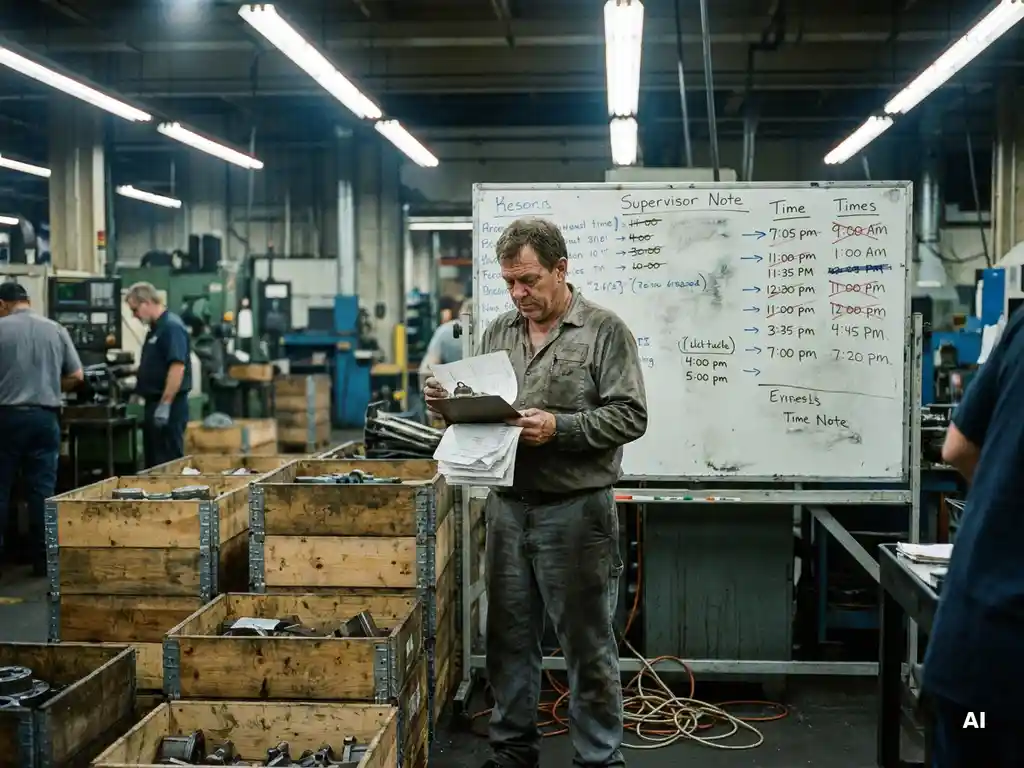
Daily production planning problems are most commonly caused by inaccurate demand forecasting, poor data visibility, unplanned machine downtime, and disconnected systems that prevent planners from responding quickly to change. These issues compound one another: a forecast error triggers a scheduling adjustment, which exposes a data gap, which delays a response to an equipment failure. Manufacturers of every size face these challenges, and understanding their root causes is the first step toward solving them.
What are the most common root causes of production planning failures?
The most common root causes of production planning failures are inaccurate demand forecasts, siloed data systems, unplanned equipment downtime, poor communication between departments, and inflexible scheduling processes. These factors rarely appear in isolation. In most manufacturing environments, they interact and amplify each other, turning a single disruption into a cascade of production scheduling problems that is difficult to contain.
Production planning depends on reliable inputs: what customers will need, when machines will be available, what materials are in stock, and how much capacity exists on the shop floor. When any one of these inputs is wrong or unavailable, planners are forced to make decisions based on incomplete information. The result is a schedule that looks reasonable on paper but falls apart under real operating conditions.
The most persistent manufacturing planning challenges tend to share a common thread: they are invisible until something goes wrong. A forecast error is not obvious until orders cannot be fulfilled. A data silo is not obvious until a planner discovers that two departments have been working from different numbers. Recognizing these root causes before they trigger disruptions is what separates reactive planning from genuinely effective scheduling.
How does poor demand forecasting disrupt daily production schedules?
Poor demand forecasting disrupts daily production schedules by creating mismatches between what is produced and what customers actually need. When forecasts are too high, manufacturers overproduce and tie up capacity, materials, and storage space. When forecasts are too low, production cannot keep pace with orders, leading to rushed scheduling, overtime, and missed delivery commitments.
The disruption is rarely limited to a single day. An inaccurate forecast at the start of a planning cycle forces adjustments throughout the week. Planners must re-sequence jobs, reallocate resources, and renegotiate delivery timelines, all of which consume time and introduce new errors into the schedule. Downstream teams, including warehousing and transport, are then left reacting to changes they were not prepared for.
Forecasting problems are often rooted in data quality rather than methodology. If the historical sales data feeding a forecast contains errors, seasonal patterns are not properly accounted for, or customer demand signals are not captured in real time, even a sophisticated forecasting model will produce unreliable outputs. Improving forecast accuracy requires clean, current data and a process for regularly reviewing and adjusting predictions as conditions change.
Why do data silos cause so many production planning problems?
Data silos cause production planning problems because they prevent planners from seeing the full picture when making scheduling decisions. When inventory data lives in one system, production data in another, and customer orders in a third, planners are forced to reconcile information manually, which is slow, error-prone, and often based on figures that are already out of date by the time they are compiled.
In a siloed environment, it is common for two departments to be working from different versions of the same data. A production planner might schedule a run based on inventory levels that the warehouse team has already allocated to a different order. A purchasing team might place a supply order for materials that are already on hand, simply because the stock record was not updated in time. These misalignments create friction, waste, and rework across the entire operation.
The deeper problem with data silos is that they slow down decision-making at exactly the moments when speed matters most. When a machine goes down or a supplier delivers short, planners need accurate, real-time information to adjust the schedule. If that information is locked in disconnected systems, the response is delayed, and the disruption grows. Integrating data across functions is one of the highest-leverage steps a manufacturer can take to reduce daily production planning issues.
What role does machine downtime play in daily scheduling disruptions?
Machine downtime is one of the most immediate causes of daily scheduling disruptions in manufacturing. When a critical piece of equipment fails unexpectedly, every job scheduled on that machine must be reassigned, delayed, or rerouted. The knock-on effects spread quickly: downstream operations stall, delivery commitments are put at risk, and planners must rebuild the schedule under time pressure with limited visibility into available alternatives.
Unplanned versus planned downtime
Not all downtime carries the same risk to production schedules. Planned maintenance can be built into the schedule in advance, allowing planners to route work around it. Unplanned breakdowns, by contrast, arrive without warning and force reactive decisions. The difference in impact is significant: planned downtime is a scheduling constraint, while unplanned downtime is a scheduling crisis.
Why scheduling systems struggle with downtime
Many scheduling systems are built around the assumption that machines will be available when planned. They do not account for variable failure rates, maintenance histories, or the realistic probability that a given asset will be unavailable on any given day. When downtime occurs, these systems require manual intervention to update, which takes time and introduces the risk of further errors. Scheduling tools that integrate real-time equipment status data allow planners to respond faster and with greater accuracy when disruptions occur.
How can production planning software reduce daily scheduling problems?
Production planning software reduces daily scheduling problems by giving planners a single, accurate view of demand, capacity, inventory, and constraints and by automating the process of building and adjusting schedules when conditions change. Rather than reconciling data from multiple sources manually, planners can work from a unified picture and respond to disruptions in real time rather than hours later.
Effective supply chain planning software addresses the root causes of production scheduling problems directly. It connects data from across the operation to eliminate silos, applies demand signals to improve forecast accuracy, and models equipment availability so that downtime can be anticipated and absorbed into the schedule rather than causing a crisis. The result is a planning process that is faster, more transparent, and more resilient to the unexpected.
The value of software is not just in automation but in visibility. When planners can see the full state of the operation in one place, they can identify problems earlier, evaluate alternatives more quickly, and communicate changes to the rest of the business with confidence. This is particularly important in environments where production schedules change frequently and the cost of a wrong decision is high.
How More Optimal helps with daily production planning problems
We built More Optimal specifically to address the kinds of supply chain production planning challenges that manufacturers face every day. Our low-code SaaS platform connects your data, automates complex scheduling logic, and gives planners the real-time visibility they need to make faster, better decisions.
Here is what we help you achieve:
- Eliminate data silos: Our platform integrates data across inventory, production, orders, and logistics so planners always work from a single, accurate source of truth.
- Improve demand forecasting: Built-in forecasting tools use clean, connected data to generate more reliable demand signals and reduce the cascade of problems that follows a forecast error.
- Handle machine downtime faster: Real-time capacity visibility means planners can reassign work and rebuild schedules quickly when equipment is unavailable, rather than losing hours to manual rescheduling.
- Automate scheduling adjustments: Our optimization algorithms handle the complexity of re-sequencing jobs, reallocating resources, and balancing constraints so planners can focus on decisions rather than data entry.
- Scale without complexity: As a cloud-based, low-code solution, More Optimal can be deployed and adapted quickly, without the long implementation timelines of traditional enterprise systems.
If daily production planning problems are costing your operation time, capacity, and customer trust, we would like to show you what a better approach looks like. Request a demo to see the More Optimal platform in action, or contact us to discuss your specific planning challenges.