
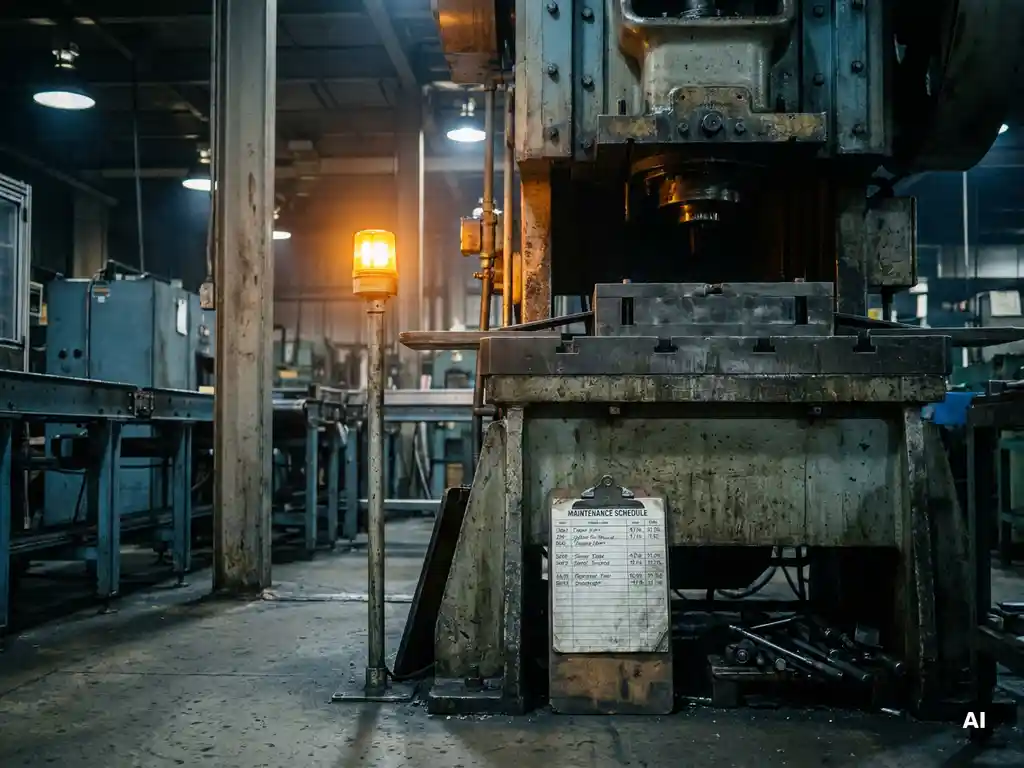
You plan around unexpected machine downtime by building flexibility into your production schedule from the start, through buffer capacity, alternative routings, and real-time rescheduling logic. When a machine fails without warning, the goal is to minimize the ripple effect on downstream operations, customer commitments, and overall output. The sections below walk through the most common questions manufacturers face when downtime strikes.
What happens to your production schedule when a machine goes down?
When a machine goes down unexpectedly, your production schedule breaks at the point of failure and the disruption cascades forward. Jobs queued behind that machine stall, downstream workstations run out of input, and delivery commitments tied to affected orders become at risk. The severity depends on how central that machine is to your routing and how much buffer exists in the schedule.
In practice, the immediate consequences fall into a few categories. First, work-in-progress sitting in front of the failed machine builds up with nowhere to go. Second, operators at downstream stations become idle or are forced onto unplanned tasks. Third, orders with tight deadlines get pushed back, triggering a chain of customer communication and re-planning decisions.
The less visible consequence is the planning debt that accumulates. Every manual workaround made in the heat of the moment, splitting batches, borrowing capacity from other lines, expediting raw materials, creates complexity that takes time to unwind once the machine is back online. This is why the initial response to unplanned downtime matters as much as the recovery itself.
What’s the difference between reactive and proactive downtime planning?
Reactive downtime planning means responding to a machine failure after it has already disrupted production. Proactive downtime planning means building your schedule and maintenance strategy so that failures cause the least possible disruption before they happen. The key difference is timing: one absorbs the full cost of a failure, the other distributes and reduces that cost in advance.
Reactive planning: managing the crisis
Reactive approaches rely on planner judgment, manual schedule adjustments, and ad hoc decisions made under pressure. While this is sometimes unavoidable, it tends to produce suboptimal outcomes: orders are prioritized based on who shouts loudest rather than actual business impact, and the schedule rarely returns to its optimal state quickly.
Proactive planning: designing for disruption
Proactive planning treats machine failure as a known risk rather than a surprise. It involves pre-defining alternative routings for critical jobs, scheduling planned maintenance during low-demand windows, and building slack into the schedule at strategic points. When downtime does occur, the response follows a pre-established logic rather than improvisation. The result is faster recovery and fewer downstream consequences.
How does production planning software handle unplanned downtime?
Production planning software handles unplanned downtime by detecting the disruption, assessing its impact on the current schedule, and generating a revised plan that re-sequences or re-routes affected jobs. Advanced platforms do this automatically using optimization algorithms, presenting planners with updated schedules rather than leaving them to rebuild manually.
The core mechanism is constraint-based rescheduling. The software knows which machines can perform which operations, what the current queue looks like across all workstations, and what the delivery priorities are. When a machine is marked as unavailable, the system recalculates the best possible sequence given the remaining capacity. This can account for setup times, operator availability, material readiness, and customer due dates simultaneously, something a planner doing this manually would struggle to achieve under time pressure.
Some platforms also flag the knock-on effects before they become problems: which orders will now miss their due date, which customers need to be notified, and what the revised completion times look like across the board. This turns a reactive scramble into a structured decision-making process, even when the trigger was entirely unexpected.
What data do you need to plan around machine failures effectively?
To plan effectively around machine failures, you need four categories of data: machine capability data, real-time availability status, job routing flexibility, and order priority information. Without all four, any rescheduling decision is based on incomplete information and risks creating new bottlenecks while solving the immediate one.
- Machine capability data: Which machines can perform which operations, at what speed, and with what setup requirements. This defines whether alternative routings are even possible.
- Real-time availability status: The current state of every machine and workstation, including any planned maintenance windows already in the schedule.
- Job routing flexibility: For each active job, which operations have fixed machine assignments and which can be moved to alternative equipment. Not every job can be re-routed, and knowing this upfront saves time.
- Order priority and due date data: A ranked view of which orders carry the highest business impact if delayed, so that available capacity is allocated to the right jobs first.
- Historical failure data: Mean time between failures for each machine, which informs buffer planning and helps identify which assets are highest risk.
The more of this data is structured, current, and accessible in your planning system, the faster and more accurately you can respond when a machine failure occurs.
When should you rebuild the schedule versus manually adjust it?
Rebuild the schedule when the disruption affects multiple jobs, multiple machines, or a significant share of your remaining capacity for the day or week. Make manual adjustments only when the failure is isolated to one job or one machine with a clear, simple workaround that does not affect anything else downstream.
The temptation after unplanned downtime is to make the minimum number of changes to get production moving again. This is understandable under pressure, but it often leaves the schedule in a degraded state, full of patches that interact badly with each other over the following shifts. A full reschedule, while it takes more time upfront, typically produces better overall output by the end of the planning horizon.
A useful rule of thumb: if the disruption touches more than two downstream jobs or pushes any order past its due date, treat it as a reschedule event rather than a manual fix. Modern production planning platforms can generate a revised schedule in minutes, making the cost of a full rebuild much lower than it was with spreadsheet-based planning.
How can you reduce the impact of downtime before it happens?
You reduce the impact of unplanned downtime before it happens by combining preventive maintenance scheduling, strategic buffer capacity, and alternative routing design into your standard planning process. None of these eliminates machine failure, but together they ensure that when a failure occurs, the schedule has room to absorb it.
Preventive maintenance is the most direct lever. Scheduling maintenance during planned low-demand periods keeps machines in better condition and reduces the frequency of unexpected failures. It also means that when a machine does go down, it is more likely to be a known event with a predictable recovery time rather than an open-ended crisis.
Buffer capacity, deliberately leaving some machine time unscheduled, gives you somewhere to re-route work when a failure occurs. Many manufacturers resist this because it looks like wasted capacity on paper, but the cost of a single major disruption typically far outweighs the efficiency loss from maintaining modest buffers.
Finally, designing your routings so that critical jobs have at least one alternative machine path is one of the most practical forms of downtime risk management available. It does not require any additional equipment, only a clear mapping of which operations can run where, documented and accessible in your planning system before the emergency happens.
How More Optimal helps with unplanned machine downtime
We built More Optimal to give manufacturers real control over their production schedules, including when things go wrong unexpectedly. Our low-code supply chain platform is designed to handle the complexity of downtime management without requiring planners to rebuild everything from scratch under pressure.
Here is what we offer specifically for managing machine downtime and manufacturing disruption:
- Automated rescheduling: When a machine becomes unavailable, our optimization engine recalculates the schedule across all active jobs, respecting machine capabilities, operator availability, and order priorities simultaneously.
- Alternative routing logic: We allow you to pre-define fallback routings for critical operations, so the system can immediately identify where work can move when a machine fails.
- Real-time visibility: Our platform gives planners a live view of production status, queue depths, and downstream impact, so decisions are based on current data, not yesterday’s plan.
- Priority-driven sequencing: When capacity is constrained after a failure, our algorithms allocate available resources to the orders with the highest business impact first.
- Flexible integration: We connect with your existing ERP and MES systems, so disruption data flows into the planning layer without manual entry.
If unplanned downtime is costing you output, customer confidence, or planning hours, we would like to show you how our platform handles it in practice. Request a demo and see More Optimal in action with your own production scenarios.