
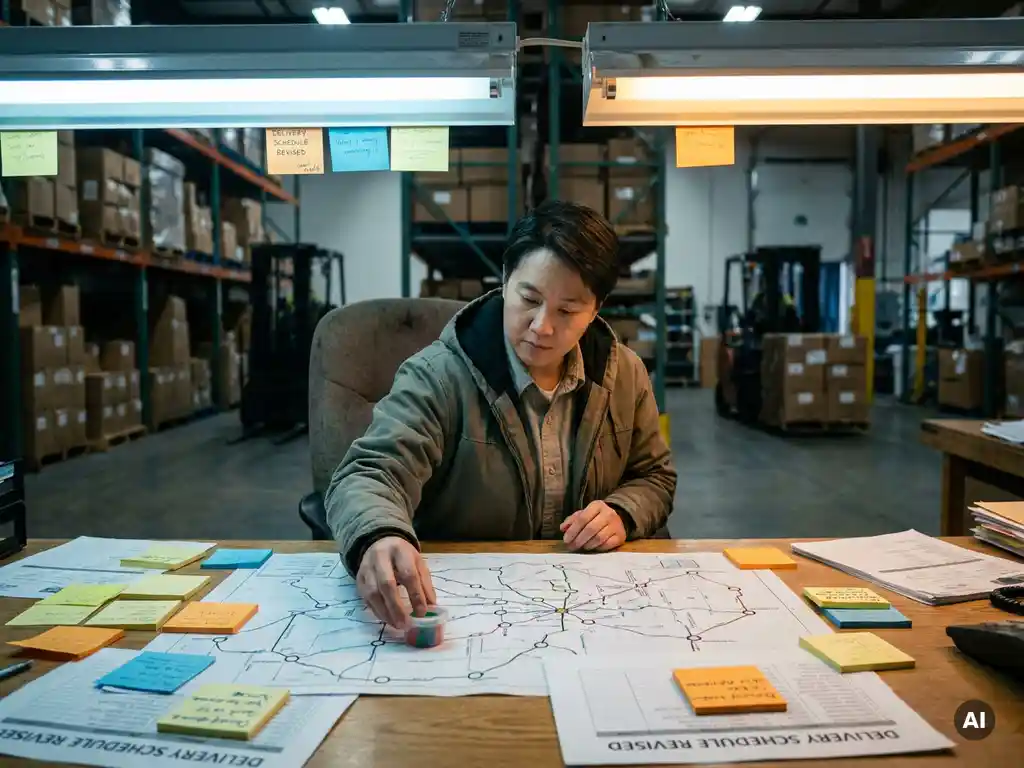
Planners respond to unexpected operational changes by first assessing the scope and urgency of the disruption, then rapidly adjusting schedules, resources, and priorities to restore flow. The most effective responses combine structured decision-making with real-time data, allowing planners to contain disruptions before they cascade across the supply chain. The questions below unpack each stage of that response in detail.
What counts as an unexpected operational change for planners?
An unexpected operational change is any event that forces a planner to deviate from an approved plan without prior warning. This includes supplier failures, sudden demand spikes, equipment breakdowns, transport delays, workforce shortages, and weather-related disruptions. What makes these events operationally significant is not just their occurrence but their timing: they arrive when resources are already committed and schedules are locked.
The severity of an unexpected change depends on three factors: how central the affected resource or route is to the overall plan, how much buffer capacity exists to absorb the shock, and how quickly the disruption is detected. A delayed shipment from a secondary supplier may be manageable; the same delay from a sole-source supplier on a critical production line is a full operational crisis. Planners must therefore distinguish between disruptions that require minor adjustments and those that demand a complete replanning cycle.
Common categories of unexpected operational changes include:
- Supply-side disruptions: late deliveries, quality rejections, supplier insolvency
- Demand-side shocks: sudden order surges, unexpected cancellations, forecast misses
- Internal failures: machine breakdowns, staff absences, system outages
- Logistics disruptions: carrier failures, port congestion, route closures
- Regulatory or compliance events: customs holds, product recalls, safety incidents
How do planners detect disruptions before they escalate?
Planners detect disruptions early by monitoring key performance indicators in real time and setting threshold-based alerts that trigger before a problem becomes a crisis. Early detection relies on a combination of live data feeds, exception reporting, and direct communication with operational teams. The faster a signal reaches a planner, the more response options remain available.
Effective early detection systems share several characteristics. They track leading indicators rather than lagging ones: inventory coverage days rather than stockouts already in progress, carrier tracking data rather than missed delivery confirmations. They also filter noise intelligently, surfacing only deviations that exceed defined tolerance bands so planners are not overwhelmed by minor fluctuations.
Beyond technology, experienced planners cultivate direct communication channels with suppliers, warehouse managers, and transport partners. A phone call from a driver reporting a road closure can reach a planner minutes before any system update reflects the delay. Combining human intelligence with automated monitoring creates the most robust early-warning capability.
What decision-making process do planners follow during a disruption?
During a disruption, planners follow a structured sequence: confirm the facts, assess the impact on the current plan, identify available response options, select the best option given constraints, and execute with clear communication. This process must be fast without being rushed, and it works best when planners have pre-defined escalation paths and fallback scenarios ready before disruptions occur.
Confirm and scope the disruption
The first step is verifying what has actually happened versus what has been reported. Planners check source data, contact relevant parties, and establish the realistic scope of the problem. Acting on incomplete or inaccurate information at this stage leads to responses that create secondary disruptions.
Evaluate options and execute
Once the scope is clear, planners map the disruption against current commitments: which orders, routes, or production runs are affected, and by how much. They then generate response options, which typically include rerouting, rescheduling, substituting resources, splitting orders, or escalating to customers. The chosen option is executed with explicit communication to all affected parties so that downstream teams can adjust their own plans accordingly.
How does planning software help respond to real-time changes?
Planning software supports real-time responses by continuously processing live operational data, recalculating optimal plans when conditions change, and presenting planners with actionable alternatives rather than raw data. Instead of manually rebuilding a schedule after a disruption, a planner can trigger a re-optimization that accounts for all current constraints simultaneously and surfaces the best available option within seconds.
Modern supply chain planning platforms contribute to disruption response in several specific ways:
- Automated alerts: threshold breaches trigger notifications before planners need to search for problems
- Scenario modeling: planners can simulate the impact of a disruption and test response options before committing
- Visual dashboards: real-time data visualizations make it immediately clear which parts of the plan are at risk
- Re-optimization engines: built-in algorithms recalculate routes, assignments, or schedules under revised constraints
- Audit trails: every decision and change is logged, supporting post-disruption review and continuous improvement
The practical effect is that planning software compresses the time between detecting a disruption and executing a response, which directly limits the downstream impact on customers and operations.
What’s the difference between reactive and proactive disruption management?
Reactive disruption management means responding after a disruption has already affected operations: a shipment has already missed its window, a machine has already stopped, an order is already late. Proactive disruption management means identifying risk signals before the disruption occurs and taking preemptive action to prevent or reduce the impact. Proactive management preserves more options and costs less than reactive recovery.
The distinction matters because reactive responses always operate under time pressure and constrained options. When a disruption has already cascaded, planners are choosing between imperfect alternatives. Proactive management, by contrast, allows planners to act while options are still open: rerouting a shipment before a weather event closes a port, adjusting a production schedule before a supplier delay creates a stockout, or rebalancing inventory across locations before demand shifts create regional shortages.
Building proactive capability requires investment in demand sensing, supplier risk monitoring, and scenario planning. It also requires organizational willingness to act on probabilistic signals rather than waiting for certainty. The operational agility this creates is one of the most durable competitive advantages in supply chain planning.
How can planners build resilience against future operational surprises?
Planners build supply chain resilience by systematically reducing single points of failure, increasing operational flexibility, and embedding learning from past disruptions into future plans. Resilience is not about eliminating surprises but about ensuring that when surprises occur, the system absorbs them without catastrophic failure.
Concrete resilience-building actions include:
- Dual sourcing critical materials: reduces dependency on any single supplier and preserves options during supply disruptions
- Maintaining strategic buffer stock: for high-risk, high-impact SKUs where stockout costs outweigh holding costs
- Developing flexible transport capacity: relationships with multiple carriers prevent single-carrier failures from halting distribution
- Documenting disruption playbooks: pre-defined response protocols reduce decision time during actual events
- Conducting regular scenario exercises: stress-testing plans against plausible disruption scenarios reveals vulnerabilities before they are exposed in practice
- Reviewing disruptions systematically: post-event analysis captures what worked, what failed, and what process changes would reduce future impact
Resilience also depends on the quality of the data planners work with. Accurate inventory positions, reliable demand signals, and up-to-date supplier lead times all reduce the gap between what the plan assumes and what is actually happening on the ground. Closing that gap is one of the most effective investments a planning organization can make in long-term operational agility.
How More Optimal helps planners respond to unexpected operational changes
We built More Optimal specifically to give planners the speed, visibility, and flexibility they need when operations deviate from plan. Our low-code supply chain platform combines real-time data processing, built-in optimization algorithms, and configurable alerting so that planners can detect, assess, and respond to disruptions faster than traditional planning tools allow.
Here is what More Optimal brings to disruption response:
- Real-time dashboards and alerts that surface exceptions the moment thresholds are breached, so planners act before disruptions escalate
- Re-optimization on demand for transport routes, job assignments, warehouse operations, and production schedules under revised constraints
- Scenario modeling tools that let planners test response options and compare outcomes before committing to a course of action
- Audit trails and reporting that support post-disruption review and continuous improvement
- Flexible integrations that connect planning data with live operational systems, reducing the lag between what happens and what planners see
- Low-code configurability that allows planning rules and workflows to be updated quickly as operational realities change
Whether you are managing transport planning, warehouse operations, manufacturing schedules, or field services, our platform is designed to keep planners in control when conditions change without warning. Request a demo to see how More Optimal supports real-time planning in your operational environment, or contact our team to discuss your specific supply chain challenges.