
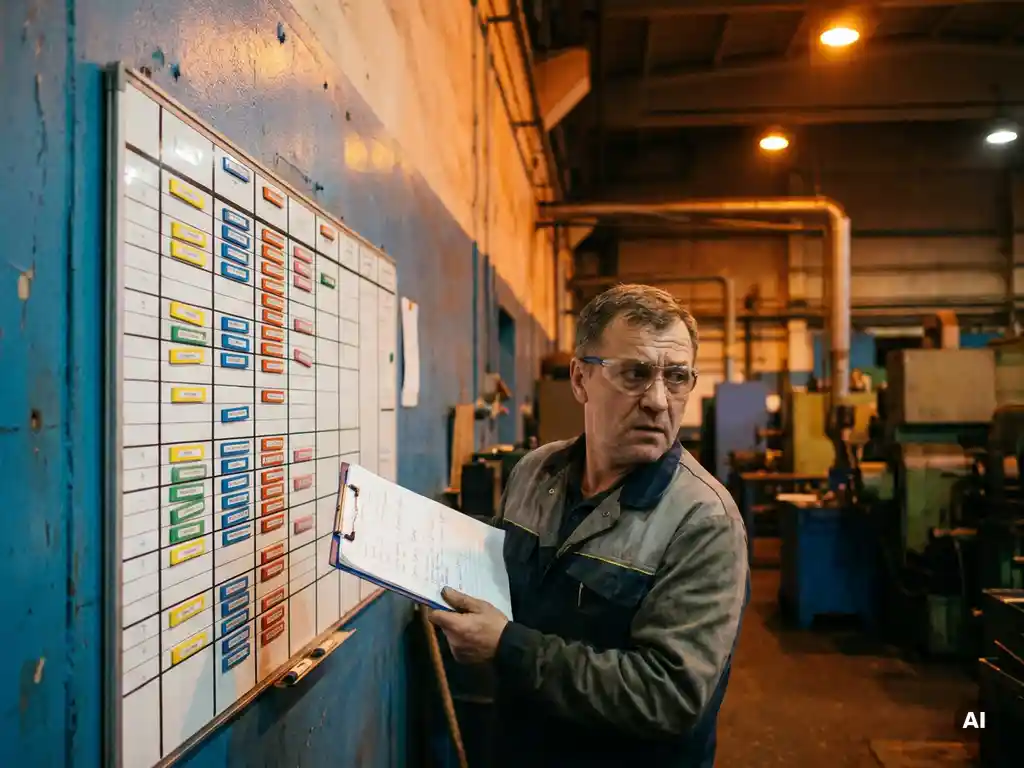
Production plans stay up to date by connecting scheduling systems directly to live operational data, so that changes in demand, capacity, or supply automatically trigger plan revisions rather than waiting for a manual update cycle. The faster a production schedule can reflect reality, the less time teams spend firefighting disruptions. The questions below break down exactly why plans fall behind and what keeps them current.
What causes production plans to become outdated so quickly?
Production plans become outdated because they are built on assumptions that change constantly. Demand shifts, suppliers deliver late, machines break down, and staff availability fluctuates. Every one of these events creates a gap between what the plan says should happen and what is actually happening on the shop floor. Without a mechanism to close that gap in near real time, the plan loses its value quickly.
The core problem is that traditional production planning treats scheduling as a periodic activity. A planner builds a schedule at the start of the week, and that schedule is expected to hold until the next planning cycle. In practice, the first disruption can invalidate large portions of it within hours. Common triggers include:
- Unexpected demand spikes or order cancellations that change production priorities
- Raw material shortages or late supplier deliveries that block scheduled production runs
- Equipment failures or unplanned maintenance that remove capacity from the schedule
- Workforce absences that reduce available labor on a given shift
- Quality failures that require rework and consume time allocated to other jobs
Each of these events is normal in manufacturing. The issue is not that disruptions occur but that many planning systems have no reliable way to detect them quickly and recalculate the schedule in response. The longer the lag between a disruption and a plan update, the more downstream decisions are made on inaccurate information.
How does real-time data keep production schedules accurate?
Real-time data keeps production schedules accurate by feeding current operational conditions directly into the planning system, so that the schedule reflects what is actually possible rather than what was assumed at the time of planning. When machine status, inventory levels, and order progress are visible live, planners and algorithms can adjust sequences, shift priorities, and reallocate capacity before small delays compound into larger problems.
The practical value of real-time production updates comes from shortening the feedback loop. When a machine goes offline, a connected system knows immediately and can recalculate which jobs need to be rerouted or rescheduled. When a customer order is expedited, the system can identify the earliest feasible slot and flag any conflicts with existing commitments. This kind of responsiveness is impossible when data is entered manually or collected in batches at the end of a shift.
Key data streams that support real-time production accuracy include live inventory levels, machine utilization and downtime signals, work-in-progress status by job or batch, and inbound supply confirmations. When these inputs flow continuously into the scheduling engine, the production plan becomes a living document rather than a static snapshot.
What’s the difference between static and dynamic production planning?
Static production planning creates a fixed schedule at a set point in time and holds it until the next formal planning cycle, while dynamic production planning continuously adjusts the schedule as conditions change. The key distinction is responsiveness: static plans are built once and followed, whereas dynamic plans are revised automatically or on demand whenever new information arrives.
Static production planning
Static planning works best in highly stable environments where demand is predictable, lead times are consistent, and disruptions are rare. The plan is optimized at the point of creation, and the goal is to execute it as written. The main limitation is that any deviation from the plan’s assumptions requires manual intervention to correct, which introduces delay and relies heavily on planner availability and judgment.
Dynamic production planning
Dynamic production planning, by contrast, treats the schedule as a continuously updated output of the planning system. Changes in demand, capacity, or supply are detected automatically, and the system recalculates feasible schedules in response. This approach suits manufacturers operating in volatile markets, those handling complex product mixes, or any operation where customer requirements change frequently. Dynamic planning does not eliminate the need for human oversight, but it shifts the planner’s role from manual schedule maintenance to exception management and decision validation.
How can supply chain software automate production plan updates?
Supply chain software automates production plan updates by integrating with operational data sources, applying optimization algorithms to recalculate feasible schedules, and surfacing revised plans to planners for review or direct execution. Automation removes the manual step of identifying a disruption, assessing its impact, and rebuilding the schedule by hand, compressing a process that might take hours into seconds.
Effective supply chain planning software connects to ERP systems, warehouse management tools, machine sensors, and order management platforms to maintain a current picture of available capacity and demand. When the system detects a change, it runs optimization logic against the updated inputs and produces a revised production schedule that respects constraints such as machine capacity, material availability, shift patterns, and delivery deadlines.
Automation also supports scenario planning. Rather than committing immediately to a single revised schedule, planners can use the software to compare multiple feasible options and choose the one that best balances competing priorities such as on-time delivery, resource utilization, and changeover efficiency. This combination of automation and human decision-making produces more reliable manufacturing scheduling outcomes than either approach alone.
When should a production plan be manually reviewed versus auto-updated?
A production plan should be auto-updated when the change falls within predefined rules and constraints that the system can resolve without human judgment, such as minor sequence adjustments or small capacity rebalances. Manual review is warranted when a disruption is significant enough to affect customer commitments, require cross-functional decisions, or involve trade-offs that the system cannot evaluate on its own.
Setting clear thresholds is the practical way to manage this balance. Many operations define rules such as: if a delay affects a job by less than two hours and no customer delivery date is at risk, the system updates the schedule automatically. If a delay pushes a confirmed order past its due date, a planner is alerted and must approve the revised plan before it is released to the shop floor.
Manual review is also appropriate in situations that fall outside the system’s modeled constraints, for example when a key supplier relationship is at stake, when a strategic customer needs a personal response, or when multiple simultaneous disruptions create a scenario the algorithm has not been configured to handle. The goal is not to automate every decision but to reserve planner attention for the decisions that genuinely require it, while routine adjustments are handled without delay.
How More Optimal helps with production plan accuracy
We built More Optimal specifically to close the gap between static, outdated schedules and the dynamic reality of modern manufacturing and supply chain operations. Our low-code platform connects to your existing data sources and applies powerful optimization algorithms to keep your production schedule aligned with current conditions, without requiring a team of developers to maintain it.
Here is what we offer to support accurate, up-to-date production planning:
- Real-time data integration that pulls live signals from ERP systems, warehouse tools, and operational sources into a single planning environment
- Dynamic scheduling algorithms that recalculate feasible production plans automatically when demand, capacity, or supply changes
- Configurable update rules that define when the system auto-updates and when a planner review is triggered, so you stay in control
- Scenario comparison tools that let planners evaluate multiple schedule options before committing to a revised plan
- Alerts and notifications that surface exceptions requiring human judgment, keeping planners focused on high-impact decisions
- Scalable, cloud-based deployment that grows with your operation without the overhead of traditional enterprise software
If keeping your production plan accurate and responsive is a priority for your operation in 2026, we would be glad to show you how our platform works in practice. Request a demo and see what dynamic production planning looks like with More Optimal.