
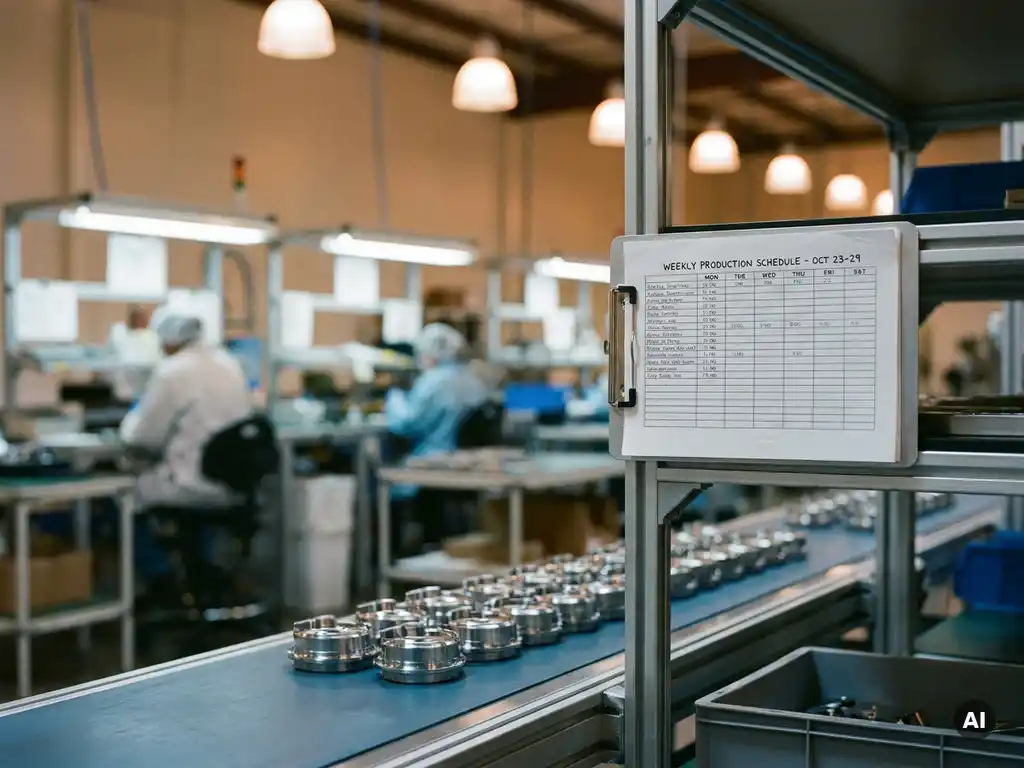
You can reduce production schedule changes by stabilizing the inputs that cause them: demand signals, supplier reliability, and internal planning processes. The most effective approach combines a frozen planning zone, structured sales and operations planning (S&OP), and software that surfaces disruptions before they cascade into schedule rewrites. The questions below unpack each of these levers in detail.
What causes frequent production schedule changes?
Frequent production schedule changes are caused by a combination of volatile demand signals, unreliable supply, poor internal coordination, and reactive planning habits. When any one of these inputs shifts unexpectedly, planners adjust the schedule to compensate, and if the root cause is never addressed, those adjustments become a permanent feature of daily operations rather than an exception.
The most common triggers of manufacturing schedule disruptions include:
- Inaccurate demand forecasts that force last-minute order insertions or cancellations
- Late or incomplete supplier deliveries that remove materials from the plan
- Unplanned machine downtime that collapses capacity assumptions
- Sales teams accepting rush orders without checking production capacity
- Weak change governance, meaning anyone can alter the schedule without a formal review
What makes this problem self-reinforcing is that frequent changes erode planner confidence in the schedule, which leads to more informal workarounds, which generate more changes. Breaking the cycle requires addressing the structural causes rather than simply managing the symptoms week to week.
How does poor demand forecasting lead to schedule disruptions?
Poor demand forecasting leads to schedule disruptions because production plans are built on demand assumptions. When those assumptions are wrong, the schedule becomes invalid before the first item is produced. Planners then scramble to insert new orders, pull forward jobs, or cancel runs that are already in progress, each of which ripples through downstream operations.
The link between forecast accuracy and schedule stability is direct. An overestimated demand figure commits capacity to products that will not ship, blocking time that urgent orders need. An underestimated figure means materials were never ordered, so production cannot start on time even when the capacity exists.
Improving forecast quality reduces this volatility at the source. Effective approaches include:
- Combining historical sales data with forward-looking signals such as confirmed orders, promotions, and seasonal patterns
- Segmenting products by demand variability and applying different forecasting methods to each segment
- Shortening the forecast review cycle so errors are caught before they reach the production floor
- Involving commercial teams in forecast sign-off so that sales intelligence is embedded in the plan
Even a modest improvement in forecast accuracy translates directly into fewer emergency schedule changes, because the plan reflects reality more closely from the outset.
What is the difference between a frozen zone and a planning horizon?
A frozen zone is a short, fixed period at the start of the production schedule during which no changes are permitted without senior approval. A planning horizon is the total forward time window the schedule covers. The frozen zone protects near-term execution stability; the planning horizon determines how far ahead the business is planning at all.
The two concepts work together but serve different purposes:
- Planning horizon: Typically spans weeks to months, depending on lead times and industry. It defines how far into the future production orders, material requirements, and capacity allocations are calculated. A longer horizon gives procurement and suppliers more lead time to respond.
- Frozen zone: Typically spans one to two weeks immediately ahead of today. Within this window, the schedule is treated as fixed. Changes require a formal escalation process, which discourages casual alterations and forces the business to absorb small disruptions rather than rewriting the plan.
Manufacturers that implement a frozen zone consistently report fewer last-minute changes, better adherence to production sequences, and lower expediting costs. The frozen zone does not eliminate flexibility, it simply moves flexibility to the right part of the horizon, where there is still time to act without disrupting execution.
How can sales and operations planning reduce schedule instability?
Sales and operations planning reduces schedule instability by creating a structured, cross-functional process where demand, supply, and financial plans are reconciled before they reach the production floor. Instead of each department adjusting the schedule independently, S&OP establishes a single agreed plan that all functions commit to for a defined period.
The mechanism is straightforward. In a well-run S&OP cycle, the commercial team submits a demand plan, operations checks it against available capacity and materials, finance validates it against revenue and cost targets, and leadership signs off on the reconciled version. This happens on a regular cadence, typically monthly with weekly reviews, so that misalignments are surfaced in the planning room rather than on the production floor.
The practical benefits for production schedule stability include:
- Fewer unilateral decisions by sales or operations that override the agreed plan
- Earlier visibility of demand changes, giving planners time to respond without emergency reschedules
- A clear escalation path when a change genuinely cannot be avoided
- Shared accountability for plan performance, which reduces finger-pointing when disruptions occur
S&OP is not a software tool, it is a governance process. But it depends on reliable data to be effective, which is where supply chain planning software becomes a critical enabler.
What role does supply chain software play in stabilizing production schedules?
Supply chain planning software stabilizes production schedules by replacing manual, spreadsheet-based coordination with a connected, real-time view of demand, capacity, inventory, and supply. When planners can see the full picture in one place, they make better decisions and catch disruptions before they force a schedule rewrite.
The specific capabilities that matter most for production schedule stability are:
- Integrated demand forecasting that feeds directly into the production plan, reducing the gap between what sales expects and what operations builds
- Capacity and constraint modeling that flags overloads before they become crises
- Automated alerts that notify planners when a supplier delay or demand spike is about to invalidate the current schedule
- Scenario planning that lets teams evaluate the impact of a change before committing to it
- Audit trails and change logs that make every schedule modification visible and accountable
The shift from reactive to proactive planning is the core value. When a system flags a potential disruption three days in advance, a planner has options. When the disruption is discovered on the morning it occurs, the only option is an emergency reschedule.
How do you measure production schedule stability over time?
Production schedule stability is measured by tracking schedule adherence, the frequency of changes, and the timing of those changes relative to the execution date. These metrics together reveal whether instability is improving, worsening, or concentrated in specific products, lines, or time periods.
The most widely used metrics for schedule adherence in manufacturing include:
- Schedule adherence rate: The percentage of production orders completed as originally planned, without changes to quantity, sequence, or timing
- Number of schedule changes per week: A simple count that, tracked over time, shows whether the planning process is becoming more or less stable
- Change proximity: How close to the execution date changes are made. Changes made within the frozen zone are a strong signal of planning weakness
- Mean time to recovery: How long it takes the schedule to restabilize after a disruption, which reflects the resilience of the planning process
Measuring these metrics consistently is as important as the metrics themselves. A business that reviews schedule stability monthly in its S&OP process creates a feedback loop that drives continuous improvement. Without measurement, instability becomes normalized and invisible until it causes a serious customer service failure.
How More Optimal helps reduce production schedule changes
We built More Optimal specifically to give supply chain and production planning teams the tools they need to move from reactive firefighting to stable, confident planning. Our low-code platform connects demand forecasting, capacity planning, and production scheduling in a single environment, so disruptions are visible early and changes are managed with full accountability.
Here is what working with us looks like in practice:
- Integrated demand and production planning that keeps the schedule aligned with real demand signals, reducing the gap that causes last-minute changes
- Constraint and capacity modeling that flags overloads before they force a reschedule
- Configurable frozen zone enforcement that protects near-term execution from informal changes
- Automated alerts and audit trails that make every change visible, traceable, and accountable
- S&OP support with scenario planning and reporting tools that give leadership the data they need to make better decisions in the planning cycle
If production schedule instability is costing your business time, margin, or customer trust, we would like to show you what is possible. Request a demo to see the platform in action, or contact us to discuss your specific planning challenges.