
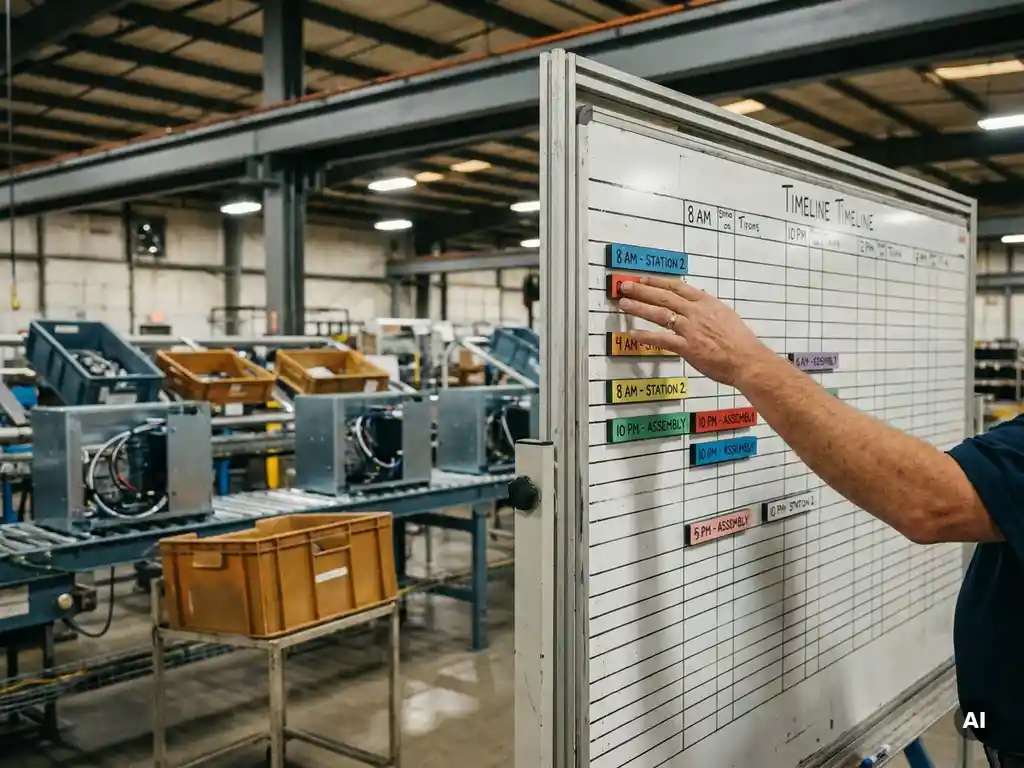
You can replan production faster by combining real-time data visibility with scheduling software that recalculates plans automatically when disruptions occur. The key is reducing the time between detecting a problem and acting on it, from hours or days to minutes. The sections below unpack the most common questions around production replanning, from what causes breakdowns to when full automation makes sense.
What causes production plans to break down?
Production plans break down when real-world conditions deviate from the assumptions the plan was built on. The most common triggers are machine breakdowns, supplier delays, sudden shifts in demand, workforce absences, and quality failures that pull orders back into the production queue. Any one of these can create a cascade of scheduling conflicts that the original plan cannot absorb.
The underlying problem is that most production plans are built as static documents. They reflect a snapshot of capacity, material availability, and demand at a specific moment. As soon as one variable changes, the entire sequence can become invalid. In manufacturing environments with tight lead times or high product mix, even a short machine stoppage can ripple across multiple orders and shift deadlines by days.
Production plan disruption is also frequently caused by poor data quality. When planners work from inaccurate inventory counts, outdated routing times, or incomplete order information, the plan starts with flawed assumptions. Replanning then becomes harder because the team first has to reconcile what the system says with what is actually on the shop floor.
How long does production replanning typically take?
In organizations without dedicated scheduling software, production replanning typically takes between two and eight hours, and in complex environments it can take a full day or more. This time is spent gathering updated data, identifying which orders are affected, recalculating sequences manually, and communicating changes to the shop floor. With dynamic production scheduling tools, the same process can take minutes.
The gap between manual and software-assisted replanning is significant. Manual replanning relies on planners holding a mental model of capacity, constraints, and priorities simultaneously. As the number of machines, orders, or product variants increases, this becomes exponentially harder. Errors increase, and planners often default to conservative decisions to avoid risk, which reduces throughput.
Speed matters because every hour a plan sits misaligned with reality is an hour of lost capacity, delayed orders, or idle labor. The faster a team can replan production, the smaller the operational impact of any given disruption.
What data do you need to replan production quickly?
Fast production replanning requires four categories of real-time data: current machine and resource availability, live inventory and material status, the priority and deadline of all open orders, and accurate routing and cycle time data for each product. Without all four, replanning produces a new schedule that is as fragile as the one it replaced.
Machine availability data must reflect actual status, not planned status. If a machine is down for unplanned maintenance, the scheduling system needs to know immediately. Similarly, material availability must reflect what is physically in stock and confirmed on inbound deliveries, not just what the purchase order says.
Order priority data is often underestimated. When multiple orders are disrupted simultaneously, planners need clear rules for which orders take precedence. Without agreed priority logic built into the data, replanning becomes a negotiation rather than a calculation, which slows everything down.
Routing and cycle time accuracy is the foundation. If the system believes a job takes four hours when it actually takes six, every schedule it produces will be wrong from the start. Regular calibration of these parameters is as important as the replanning process itself.
How does production scheduling software speed up replanning?
Production scheduling software speeds up replanning by automating the recalculation of sequences, capacity loads, and delivery timelines the moment a disruption is registered. Instead of a planner manually working through affected orders, the software applies constraint-based algorithms to generate a revised schedule in seconds, surfacing the best available option given current conditions.
The core advantage is that the software holds all relevant constraints simultaneously: machine capacities, shift patterns, material availability, order priorities, and customer deadlines. A human planner can track some of these at once, but not all of them across hundreds of orders. Software removes that cognitive ceiling.
Beyond speed, supply chain planning software also improves replanning quality. It can evaluate multiple scenarios and surface trade-offs that a manual process would miss. For example, it might show that accepting a one-day delay on a lower-priority order allows two higher-priority orders to be completed on time, a trade-off that is difficult to see without computational support.
Visualization tools within scheduling platforms also reduce the time planners spend communicating changes. Interactive Gantt charts and capacity views make it immediately clear which orders are affected and what the revised plan looks like, so shop floor teams can act without waiting for updated spreadsheets or manual briefings.
What’s the difference between reactive and proactive replanning?
Reactive replanning happens after a disruption has already affected the schedule. Proactive replanning happens before the disruption causes a problem, by detecting early warning signals and adjusting the plan in advance. Proactive replanning is faster and less costly because it avoids the downstream cascade that reactive replanning has to untangle.
Reactive replanning
In reactive mode, the trigger for replanning is a visible problem: a machine stops, a delivery fails to arrive, or an order misses its start time. By the time the planner responds, other orders may already be delayed. Reactive replanning is necessary and unavoidable in some cases, but it is always more expensive than prevention because it involves recovering lost time rather than reallocating it.
Proactive replanning
Proactive replanning uses leading indicators to act before impact. These signals include predictive maintenance alerts, supplier lead time warnings, demand spikes from sales data, or capacity utilization trends that show a bottleneck forming. When planners or systems detect these signals early, they can adjust sequences, pull forward orders, or source alternative materials before the disruption reaches the shop floor. This approach requires better data integration and, increasingly, algorithmic support to monitor signals continuously.
When should production replanning be fully automated?
Production replanning should be fully automated when the volume of orders, machines, or variables exceeds what a human planner can manage in real time, and when the cost of delayed replanning is high. High-mix, high-volume environments, continuous production operations, and businesses with very short customer lead times are the strongest candidates for full automation.
Full automation means the system detects a disruption, calculates a revised schedule, and releases it to the shop floor without requiring a planner to approve each change. This is appropriate when the business has well-defined priority rules, reliable data feeds, and confidence in the scheduling logic. It is not appropriate when exceptions are frequent and require human judgment about customer relationships, strategic priorities, or unusual constraints.
A practical approach for most manufacturers is partial automation: the system generates revised plans automatically, but a planner reviews and approves them before release. This combines the speed of algorithmic replanning with human oversight for edge cases. As confidence in the system grows and exception rates fall, the level of automation can increase incrementally.
In 2026, more manufacturers are moving toward this model as supply chain software platforms become more capable of handling complex constraint sets and integrating with real-time shop floor data. The decision to automate is ultimately a question of data quality and rule clarity: when both are high, automation delivers consistent results faster than any manual process can.
How More Optimal helps with production replanning
We built our platform specifically to give manufacturers the speed and flexibility that production replanning demands. More Optimal is a low-code supply chain SaaS platform that combines constraint-based scheduling algorithms with real-time data visualization, so your team can detect disruptions early and respond with a revised plan in minutes rather than hours.
- Dynamic scheduling engine: Our algorithms recalculate production sequences automatically when capacity, material, or order data changes, accounting for all constraints simultaneously.
- Real-time data integration: We connect to your existing systems to pull live inventory, machine status, and order data, so every plan reflects actual shop floor conditions.
- Scenario comparison: Planners can evaluate multiple replanning options side by side and choose the best trade-off between delivery performance, cost, and capacity utilization.
- Configurable automation levels: From fully manual approval to fully automated release, you control how much human oversight stays in the loop as your confidence in the system grows.
- Visual dashboards: Interactive Gantt charts and capacity views make it immediately clear what changed and why, reducing communication time across the production team.
If faster, smarter production replanning is a priority for your operation, we would be glad to show you what the platform can do. Request a demo and see how More Optimal fits your manufacturing environment.