
Archieven: Insights

Brass gauges and dials displaying supply chain metrics arranged on mahogany desk with warm golden lighting and shallow depth of field

What are supply chain innovation metrics?

Supply chain innovation metrics are specialized performance indicators that measure how effectively organizations are advancing their supply chain capabilities through new technologies, processes, and strategic approaches. Unlike traditional KPIs that focus on operational efficiency, innovation metrics track transformation progress, technology adoption rates, and the business impact of supply chain modernization initiatives. Why is outdated measurement…

Lees meer...
Autonomous delivery truck with spinning LIDAR sensor casting red laser beams to map warehouse district during golden hour

How does LIDAR improve autonomous vehicle navigation?

LIDAR (Light Detection and Ranging) improves autonomous vehicle navigation by creating precise, real-time 3D maps of the vehicle’s surroundings using laser pulses. This technology enables self-driving cars to detect obstacles, measure distances accurately, and navigate safely in various weather and lighting conditions, providing the detailed spatial awareness necessary for autonomous decision-making. Why are outdated navigation…

Lees meer...
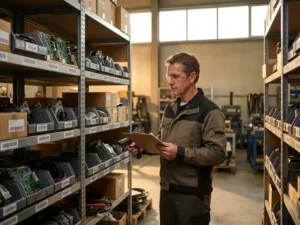
Warehouse manager with clipboard examining organized shelves of automotive parts and electronic components in industrial facility

How do you optimize vendor managed inventory?

Vendor managed inventory (VMI) optimization transforms traditional supplier relationships by shifting inventory responsibility to vendors while implementing data-driven controls and performance metrics. This collaborative approach reduces carrying costs by 15-25%, improves stock availability to 98%+, and eliminates the administrative burden of manual replenishment processes. The key lies in establishing clear performance agreements, real-time visibility systems,…

Lees meer...
Architectural blueprint of warehouse facilities and distribution centers on mahogany table with compass and ruler in natural light

What is supply chain service design?

Supply chain service design is the strategic process of architecting and optimizing every touchpoint in your supply chain to deliver exceptional customer value while maximizing operational efficiency. Unlike traditional approaches that focus purely on cost reduction or speed, service design takes a holistic view of how each supply chain component impacts the customer experience, from…

Lees meer...
Warehouse worker's hands making stop gesture toward halting forklift driver amid industrial shelving and pallets in golden hour lighting

How does gesture recognition improve worker safety?

Gesture recognition technology transforms workplace safety by using computer vision and machine learning to monitor worker movements in real time, automatically detecting unsafe behaviors, proximity to hazards, and potential accident scenarios. This technology analyzes body posture, hand movements, and spatial relationships to trigger immediate alerts, preventing injuries before they occur across manufacturing, construction, and logistics…

Lees meer...
Consultant adjusting miniature supply chain models on conference table with warehouse layouts and shipping containers while colleagues observe in professional boardroom

What are supply chain rapid prototyping methods?

Supply chain rapid prototyping methods enable organizations to test and validate new processes, systems, or strategies quickly before full-scale implementation. These iterative approaches allow companies to experiment with supply chain optimization strategies in controlled environments, reducing risk while accelerating innovation and improving operational performance. Why are slow supply chain changes costing you competitive advantage? Traditional…

Lees meer...
Professional hands organizing scattered vendor contracts and invoices into three neat stacks on polished wooden conference table

How do you optimize vendor consolidation strategies?

Vendor consolidation involves reducing the number of suppliers in your supply chain by strategically selecting fewer, higher-performing partners to handle larger volumes of goods or services. This supply chain optimization strategy streamlines procurement processes, reduces complexity, and creates stronger partnerships that drive better performance and cost savings across your entire operation. Why are fragmented vendor…

Lees meer...
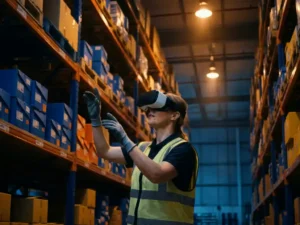
Warehouse worker wearing VR headset gestures while interacting with virtual data among tall shelving units filled with colorful boxes

How does spatial computing improve warehouse visualization?

Spatial computing in warehouse management represents a transformative approach that overlays digital information onto physical warehouse environments, creating interactive 3D visualizations that enable real-time monitoring, planning, and optimization of warehouse operations. This technology combines augmented reality, virtual reality, and mixed reality with advanced analytics to help warehouse managers visualize inventory flows, optimize layouts, and improve…

Lees meer...
Wooden conference table with colorful world maps marked by pins showing global supplier locations

How do you optimize supplier diversification?

Supplier diversification is the strategic practice of distributing procurement across multiple suppliers rather than relying on a single source or a concentrated supplier base. This approach reduces dependency risks, enhances supply chain resilience, and creates competitive leverage through multiple sourcing options. Effective diversification balances risk mitigation with cost efficiency while maintaining quality standards across your…

Lees meer...
Overhead view of warehouse conveyor belt network with orange packages flowing through junction points in modern distribution center

How do you optimize load balancing algorithms?

Load balancing algorithms are mathematical formulas and rules that determine how incoming network traffic is distributed across multiple servers or resources in a computing system. These algorithms ensure no single server becomes overwhelmed while others remain idle, creating optimal resource utilization and maintaining system performance under varying demand conditions. Why is poor load distribution costing…

Lees meer...