
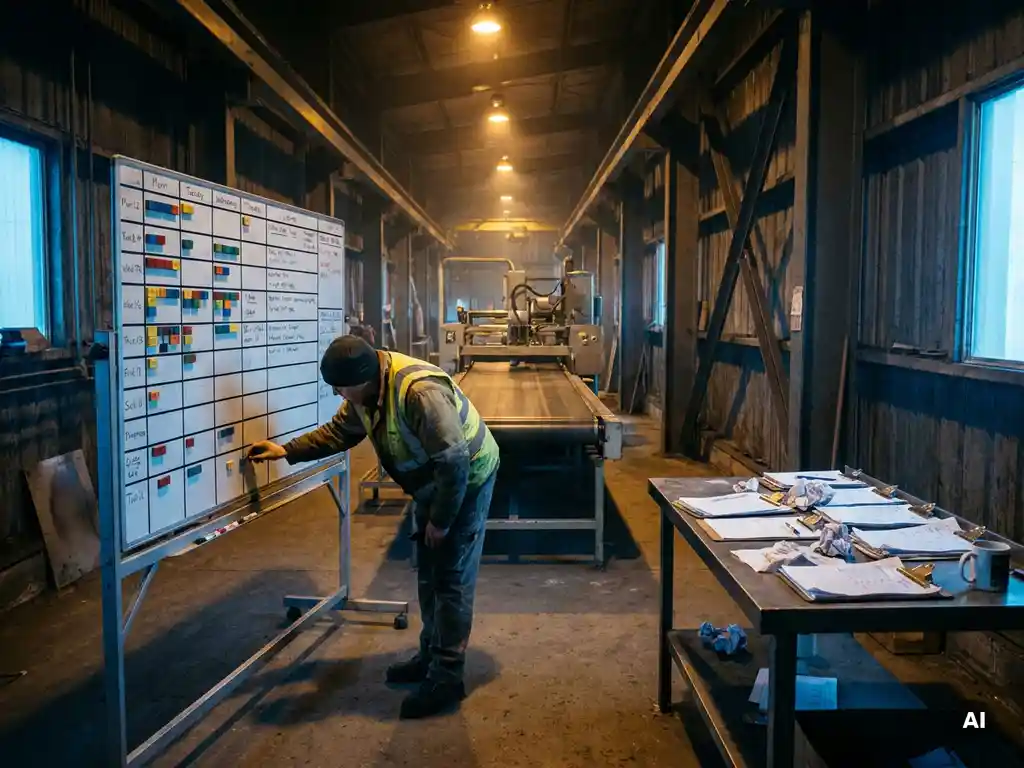
The fastest way to rebuild a production schedule is to use algorithmic rescheduling software that can instantly recalculate constraints, priorities, and resource availability across your entire operation. Manual rescheduling is too slow and error-prone when disruptions cascade across multiple lines, shifts, or suppliers. The sections below unpack exactly what drives fast recovery and which decisions matter most.
Why do production schedules break down so quickly?
Production schedules break down quickly because manufacturing operations are tightly coupled systems where a single disruption, such as a machine failure, a late delivery, or an absent operator, propagates through every dependent task almost instantly. Unlike a simple to-do list, a production schedule carries interdependencies between jobs, resources, and time windows that collapse the moment one variable changes unexpectedly.
Several factors make schedules especially fragile:
- Resource contention: Machines, tools, and skilled workers are shared across multiple jobs. When one resource becomes unavailable, every job waiting for it is immediately affected.
- Sequence dependencies: Many manufacturing processes require a specific order of operations. A delay early in a sequence blocks everything downstream.
- Tight delivery windows: Customer commitments leave little buffer. Even a modest delay can breach a promised delivery date and trigger penalty clauses or lost orders.
- Demand volatility: Rush orders, cancellations, or last-minute specification changes force replanning mid-execution, not just at the start of a shift.
Understanding why disruptions spread so fast is the first step to building a recovery strategy that is genuinely quick rather than reactive.
What information do you need before rebuilding a schedule?
Before you can reschedule production effectively, you need a clear snapshot of four things: which jobs are still open and at what stage of completion, which resources are currently available, what the updated delivery priorities are, and what constraints remain fixed versus flexible. Without this information, any new schedule is built on guesswork.
Specifically, gather the following before touching the schedule:
- Current job status: Which orders are partially complete, which are untouched, and which are already late.
- Resource availability: Which machines are operational, which workers are present, and what materials are in stock.
- Updated due dates and priorities: Confirm with sales or customer service whether any deadlines have shifted or whether certain orders now take precedence.
- Constraint inventory: Identify which scheduling rules are hard constraints (regulatory requirements, changeover minimums) versus soft preferences that can be relaxed under pressure.
Collecting this data quickly is itself a bottleneck in many plants. Organizations that connect their planning platform to live shop-floor data can compress this information-gathering phase from hours to minutes.
How does manual rescheduling compare to algorithmic rescheduling?
Manual rescheduling relies on a planner’s experience and judgment to reassign jobs one by one, while algorithmic rescheduling uses optimization logic to evaluate thousands of possible sequences simultaneously and return the best feasible solution in seconds. For small disruptions affecting one or two jobs, manual adjustment can be adequate. For anything larger, algorithms win on both speed and solution quality.
The limits of manual rescheduling
A skilled planner working manually can typically hold five to ten interdependencies in mind at once. In a real production environment with dozens of jobs, multiple machines, and shifting priorities, this cognitive ceiling means manual rescheduling almost always produces a locally reasonable but globally suboptimal result. It also takes time, often hours, during which the shop floor is either idle or running on an outdated plan.
What algorithmic rescheduling adds
Algorithmic rescheduling evaluates the entire problem space, respects all constraints simultaneously, and can incorporate objectives like minimizing tardiness, maximizing throughput, or balancing resource utilization. The result is not just faster but provably better. Modern supply chain planning software allows planners to set their own priorities and rules, so the algorithm reflects the business’s actual goals rather than a generic optimization target.
What scheduling rules speed up recovery the most?
The scheduling rules that speed up manufacturing schedule recovery the most are earliest due date prioritization, constraint-based sequencing, and frozen horizon policies. These rules reduce the search space for replanning and prevent cascading changes from spreading further than necessary.
- Earliest due date (EDD): Prioritizing jobs closest to their delivery deadline prevents late orders from becoming later while the replanning process runs.
- Constraint-first sequencing: Lock in jobs that have the fewest alternative slots first. Flexible jobs fill the gaps around constrained ones, not the other way around.
- Frozen horizons: Define a near-term window (for example, the next four to eight hours) where the schedule is locked and only the remaining horizon is open to replanning. This protects work already in progress from unnecessary disruption.
- Bottleneck protection: Identify your capacity-constraining resource and schedule it first. Every other resource is scheduled to feed it optimally.
Building these rules into your planning logic, rather than relying on planners to apply them manually under pressure, is what makes recovery fast and consistent across different disruption types.
When should you do a full reschedule versus a partial fix?
A partial fix is appropriate when the disruption is localized, affecting only one machine or a small cluster of jobs, and the rest of the schedule remains valid. A full reschedule is necessary when the disruption changes the resource or priority landscape broadly enough that a patchwork repair would create new conflicts elsewhere in the plan.
Use a partial fix when:
- Only one resource is affected and alternatives exist
- The disruption is short-duration and jobs can simply be shifted forward
- Customer priorities have not changed
Trigger a full reschedule when:
- A key bottleneck resource is unavailable for an extended period
- Multiple jobs are now late simultaneously
- A large rush order has arrived that displaces existing commitments
- Upstream supply chain planning assumptions have changed, such as a material shortage
The risk of defaulting to a partial fix when a full reschedule is needed is that you accumulate small conflicts that compound over a shift or day, eventually forcing a more disruptive correction than an early full reschedule would have required.
What tools or software make production rescheduling faster?
Production rescheduling is fastest when supported by software that combines real-time data integration, constraint-based optimization engines, and visual plan management in a single environment. Spreadsheets and standalone MES systems slow recovery because they require manual data transfer and cannot evaluate complex interdependencies automatically.
The most effective production planning software for rapid rescheduling typically offers:
- Live data connectivity: Automatic updates from machines, ERP systems, and warehouse management tools so the schedule always reflects reality
- Drag-and-drop visual scheduling: Planners can see the impact of a change before committing to it
- Built-in optimization algorithms: One-click or automated rescheduling that respects all constraints and priorities simultaneously
- Scenario comparison: The ability to run multiple recovery options side by side and select the best outcome
- Alerts and notifications: Proactive signals when a disruption is detected, so recovery starts immediately rather than after a planner notices the problem
How More Optimal helps you rebuild production schedules faster
We built More Optimal specifically to solve the problem of slow, error-prone production rescheduling. Our low-code supply chain SaaS platform gives manufacturers the tools to model their exact scheduling rules, connect to live operational data, and let powerful optimization algorithms do the heavy lifting when disruptions occur.
Here is what we offer for production scheduling recovery:
- Custom constraint modeling: Define your hard and soft scheduling rules once, and every reschedule respects them automatically
- Algorithmic optimization: Our built-in algorithms evaluate your full job mix and resource landscape to generate an optimal revised schedule in seconds
- Visual plan management: Planners can inspect, adjust, and approve the rescheduled plan through an intuitive visual interface
- Real-time alerts: Automated notifications flag disruptions the moment they occur, compressing the time between problem and recovery
- Scalable and cloud-based: Whether you operate one site or multiple locations, the platform scales without added complexity
If production schedule disruptions are costing you time, customer trust, or operational efficiency, we would like to show you what faster recovery looks like in practice. Request a demo and see how More Optimal transforms production rescheduling from a manual fire-fighting exercise into a controlled, optimized process.