
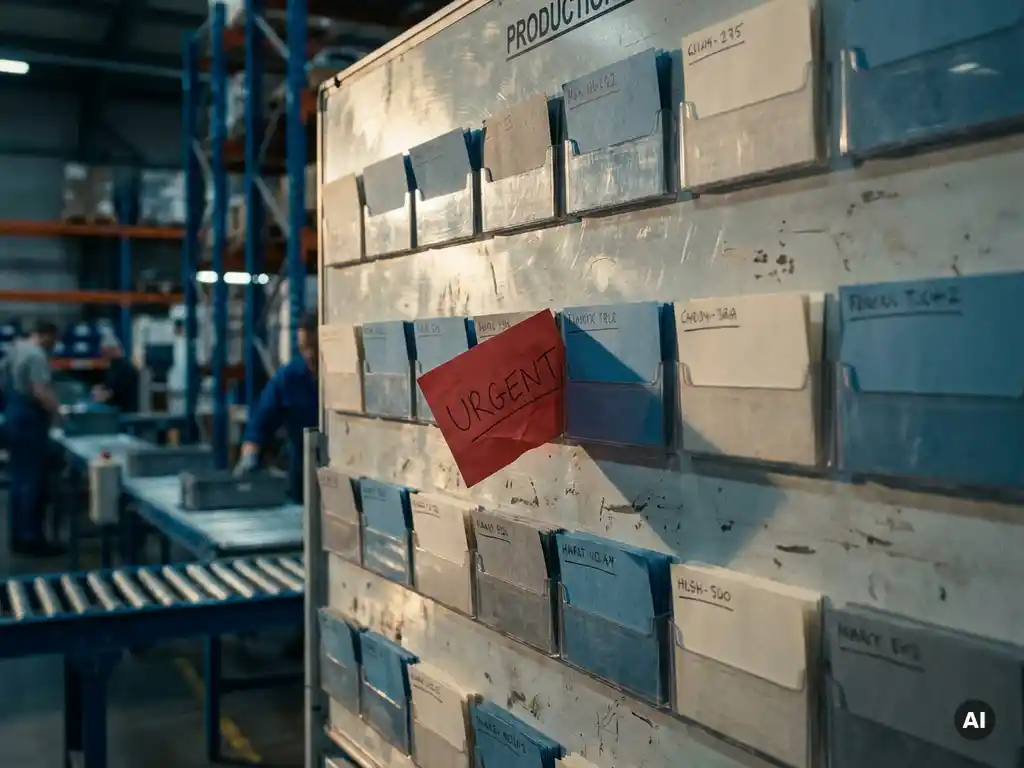
Urgent orders should be inserted into the production schedule at the earliest feasible slot that meets the required deadline without causing cascading delays to other committed orders. The right placement depends on available capacity, material readiness, and the relative cost of disruption across existing jobs. The questions below unpack exactly how to make that call, and how to prevent urgent orders from becoming a constant drain on scheduling efficiency.
How do urgent orders disrupt an existing production schedule?
Urgent orders disrupt a production schedule by forcing a reallocation of capacity, materials, and labor that was already committed to planned work. When a new order is inserted without a structured process, it typically pushes back downstream jobs, creates idle time between tasks, and puts pressure on procurement to source materials faster than planned.
The disruption is rarely limited to a single job. A schedule is a chain of dependencies, and inserting an urgent order mid-chain can break the sequence in multiple places. Machine setups get compressed, operators lose the rhythm of planned transitions, and promised delivery dates for other customers come under threat. The more tightly utilized the production floor, the more severe the ripple effect.
Beyond the operational impact, frequent schedule disruptions erode team confidence in the plan. When operators and planners know that any given schedule might change at short notice, they invest less effort in following it precisely, which compounds the inefficiency over time. Managing schedule disruption from urgent orders is therefore not just a capacity problem, it is a planning culture problem.
What factors determine where an urgent order should be placed?
The placement of an urgent order in the schedule is determined by four core factors: the order’s required completion date, the current utilization of relevant resources, material availability, and the cost of delaying other orders already in the queue. No single factor overrides the others, and the right answer emerges from weighing all four together.
- Required completion date: Work backward from the deadline to identify the latest start time that still allows the order to finish on time, including setup and quality checks.
- Resource availability: Identify which machines, workstations, or operators are needed and find the earliest window where they are genuinely free or can be freed with minimal cost.
- Material readiness: An order cannot start if components are not on hand. Confirm stock levels or procurement lead times before committing to a start slot.
- Downstream impact: Quantify what moving existing orders will cost, in terms of late delivery penalties, customer impact, and overtime, and compare that against the cost of not fulfilling the urgent request.
Effective order prioritization means treating this as a structured trade-off analysis rather than a reactive decision. Planners who document these factors consistently build institutional knowledge that makes future urgent order decisions faster and more defensible.
Should urgent orders always jump to the front of the queue?
No, urgent orders should not automatically move to the front of the queue. Front-of-queue placement is only justified when the urgency is genuine, the deadline cannot be met from any other position in the schedule, and the cost of disrupting existing orders is lower than the cost of missing the urgent deadline. Blanket front-of-queue rules create a system that rewards urgency over planning.
When every urgent order automatically jumps the queue, two problems emerge. First, customers learn that labeling an order “urgent” is the fastest way to get service, which inflates the volume of requests carrying that label. Second, the orders that were planned carefully and promised delivery dates get repeatedly pushed back, damaging reliability for the customers who did everything right.
A more effective approach is to define clear criteria for what qualifies as a genuine urgent order, assign a responsible decision-maker to approve queue jumps, and require a brief impact assessment before any insertion is confirmed. This keeps the schedule credible while still accommodating real emergencies.
How can scheduling software handle urgent order insertion automatically?
Scheduling software handles urgent order insertion automatically by running real-time optimization algorithms that evaluate available capacity, resource constraints, and existing order priorities the moment a new urgent request enters the system. Rather than requiring a planner to manually rearrange the schedule, the software calculates the least-disruptive insertion point and proposes or executes the updated plan instantly.
The key capabilities that enable this are constraint-based modeling and dynamic rescheduling. Constraint-based modeling means the software understands the rules of the production environment, such as machine compatibility, sequence-dependent setup times, and shift patterns, so it only proposes feasible slots. Dynamic rescheduling means the entire schedule is recalculated around the new insertion, not just the slot immediately before and after it.
Advanced supply chain planning platforms also provide visibility into the downstream effects of any insertion before it is confirmed. Planners can see which existing orders are affected, by how much, and make an informed approval decision in seconds rather than minutes. This transforms urgent order management from a reactive scramble into a controlled, auditable process.
What’s the difference between urgent orders and high-priority orders?
Urgent orders are defined by time pressure: they must be completed within a compressed or unexpected timeframe. High-priority orders are defined by strategic importance: they may have a standard lead time but represent a customer, contract, or revenue level that warrants preferential treatment. The two categories are distinct, and confusing them leads to poor scheduling decisions.
An urgent order that is not high-priority, for example a small replacement part needed the same day, may warrant expedited handling without displacing a high-priority batch that is central to a key account relationship. Conversely, a high-priority order that is not urgent can be planned carefully in advance, with resources allocated proactively rather than reactively.
Clear definitions matter because they drive different scheduling responses. Urgent orders require immediate capacity assessment and possible queue insertion. High-priority orders require protected scheduling windows and early material reservation. Mixing the two categories into a single “urgent and important” bucket makes it impossible to apply the right response to either type consistently.
How do you prevent urgent orders from becoming a recurring problem?
Preventing urgent orders from becoming a recurring problem requires identifying why they arise in the first place. Most recurring urgency traces back to one of three root causes: inaccurate demand forecasting, poor customer communication about lead times, or internal process failures that create delays which then require emergency recovery. Fixing the root cause eliminates the urgency, rather than just managing it better.
Improve demand forecasting accuracy
When demand forecasts are unreliable, production plans are built on shaky assumptions and real orders frequently arrive outside the expected window. Investing in better demand forecasting tools and processes, including closer collaboration with sales teams and key customers, reduces the frequency of genuinely unexpected order volumes.
Set and enforce realistic lead times
Many urgent orders are urgent only because lead times were promised without checking production capacity. When sales teams commit to delivery dates without visibility into the schedule, they inadvertently create urgency. Connecting order management to live scheduling data ensures that lead time promises are grounded in actual availability, reducing the number of orders that arrive as emergencies.
Beyond these two areas, building buffer capacity into the schedule, even a small protected window each week, gives planners a legitimate slot for genuinely unexpected requests without disrupting committed work. This is a deliberate capacity strategy, not a sign of inefficiency.
How More Optimal helps with urgent order management
At More Optimal, we help businesses take control of urgent order scheduling through our low-code supply chain platform, which is built to handle the complexity of real-world production environments. Rather than leaving planners to manually negotiate schedule changes under pressure, our platform automates the insertion analysis and gives decision-makers instant visibility into trade-offs.
- Real-time constraint-based scheduling: Our algorithms evaluate machine availability, sequence rules, and order priorities simultaneously, proposing the optimal insertion point for any urgent request.
- Impact visualization: Planners can see exactly which existing orders are affected by an insertion before confirming it, with delivery date changes displayed immediately.
- Priority rule configuration: We allow businesses to define their own priority logic, so the platform reflects your actual business rules rather than generic defaults.
- Demand forecasting integration: By connecting forecasting and production scheduling in a single platform, we help reduce the root causes of recurring urgency.
- Audit trail and alerts: Every schedule change is logged and stakeholders are notified automatically, keeping the entire team aligned without manual communication overhead.
If urgent orders are regularly disrupting your production schedule, it is a signal that your planning process needs stronger tooling. Request a demo to see how More Optimal can bring structure and speed to your order scheduling, or get in touch with our team to discuss your specific planning challenges.